
A web-based tool for qualification testing and assessment
The platform allows educators to build a question bank aligned with the labour functions of a professional standard, generate test variants, run piloting in a secure environment, and analyze results — from ongoing assessment to final certification.
System purpose
IDAP was developed by educators for educators, taking into account the real needs of the learning process and assessment practice. It is designed to organize an objective, transparent, and standardized process for assessing knowledge and skills — from ongoing assessment to final certification. The system supports the main types of test tasks, automatically generates test variants, and establishes a direct link between professional-standard labour functions and individual questions. This makes it possible not only to check knowledge but also to assess the development of specific competencies. The platform also includes advanced result analytics, enabling teachers to quickly analyze learner performance, identify weak areas, and make evidence-based pedagogical decisions.
We thank the Armed Forces of Ukraine
This project became possible thanks to those who defend our right to work, learn, and create every day. Every line of code, every learner taking a test on this platform, and every new specialist — all of this exists only because the Armed Forces of Ukraine are defending our state .
We express deep respect to the warriors of the Armed Forces of Ukraine — to those who are alive and to those who gave the highest price for our freedom. We bow deeply to the families of defenders.
Features
Ready-to-use tools without the need to write code.
Question bank
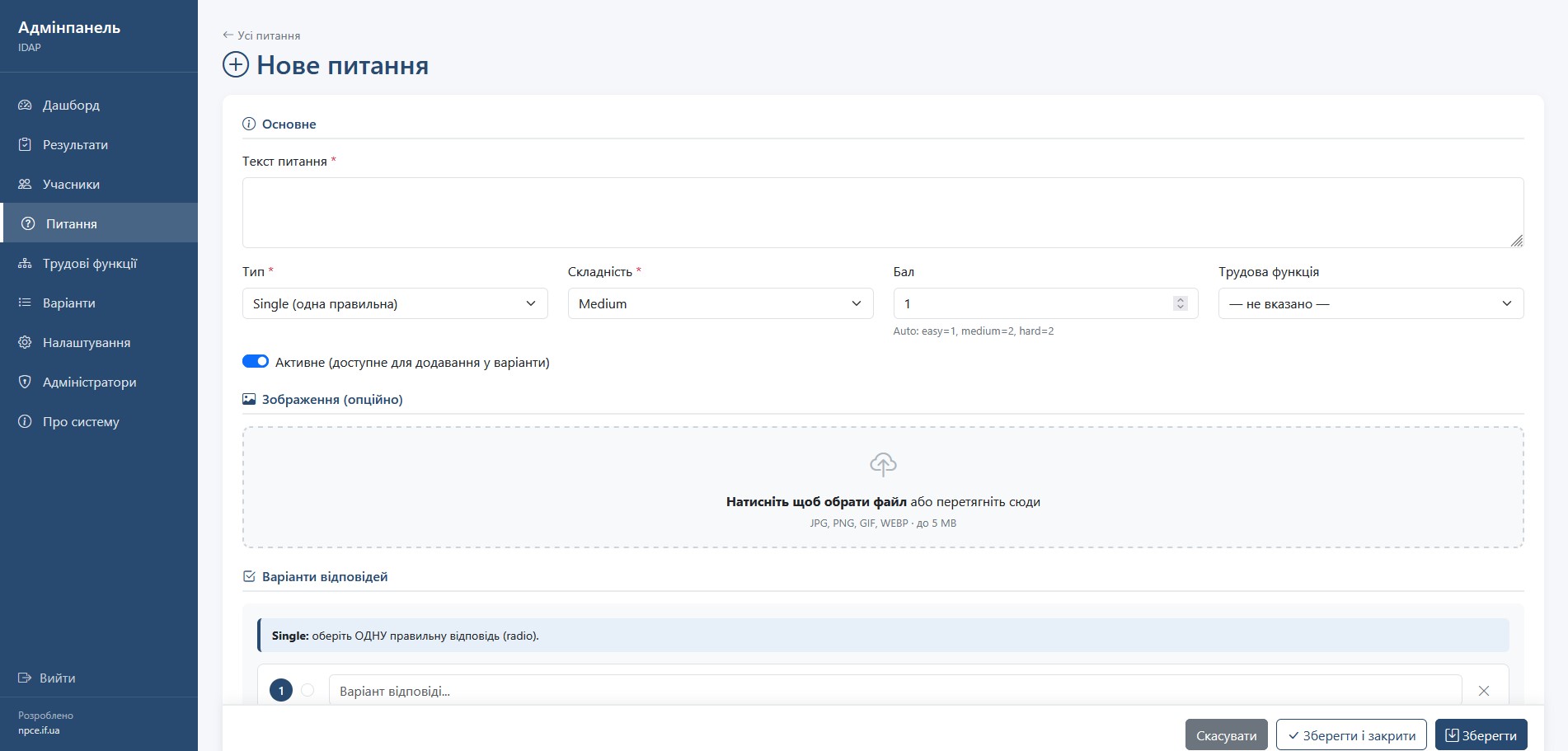
An unlimited number of questions linked to the labour functions of a professional standard, with grading by difficulty and type.
Automatic variant generation
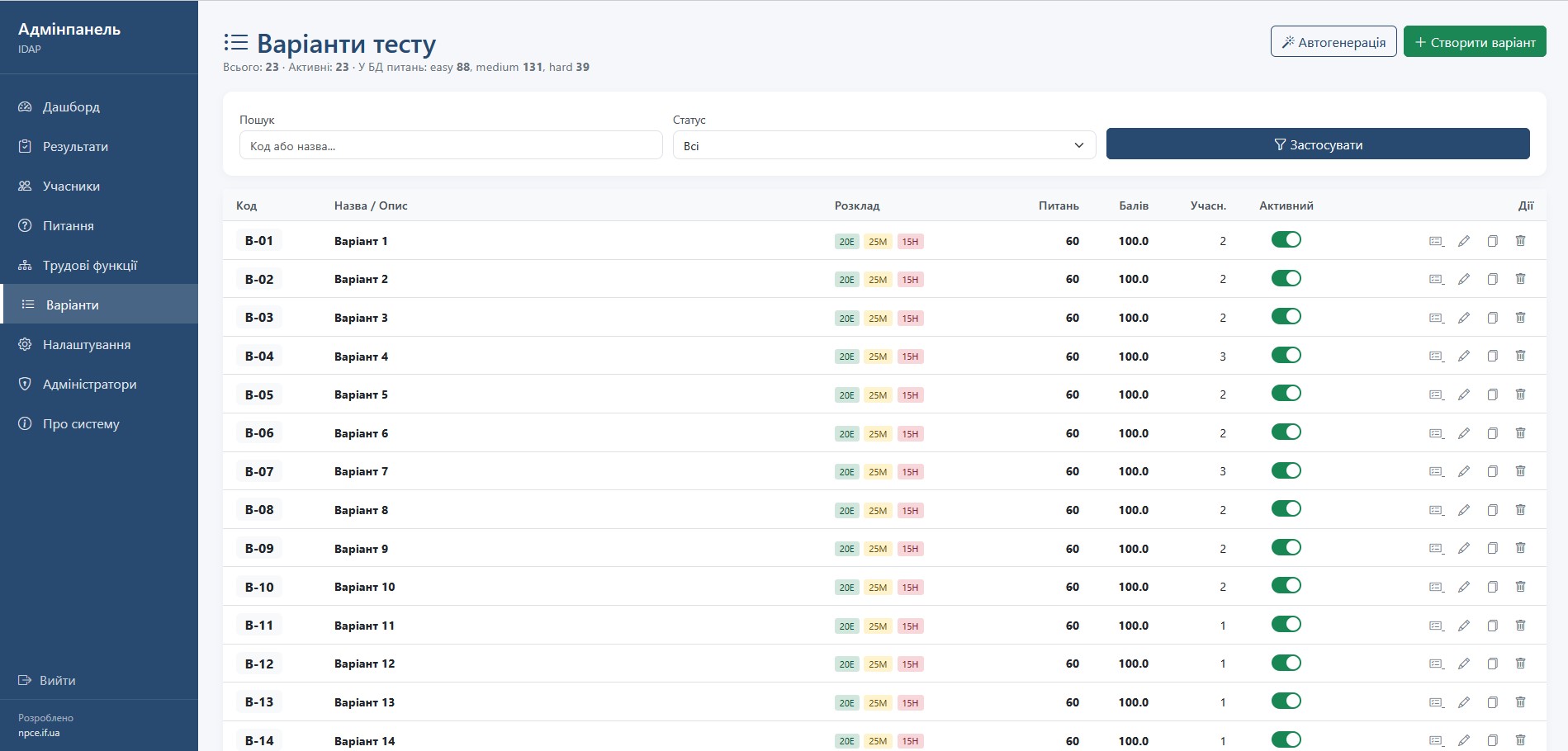
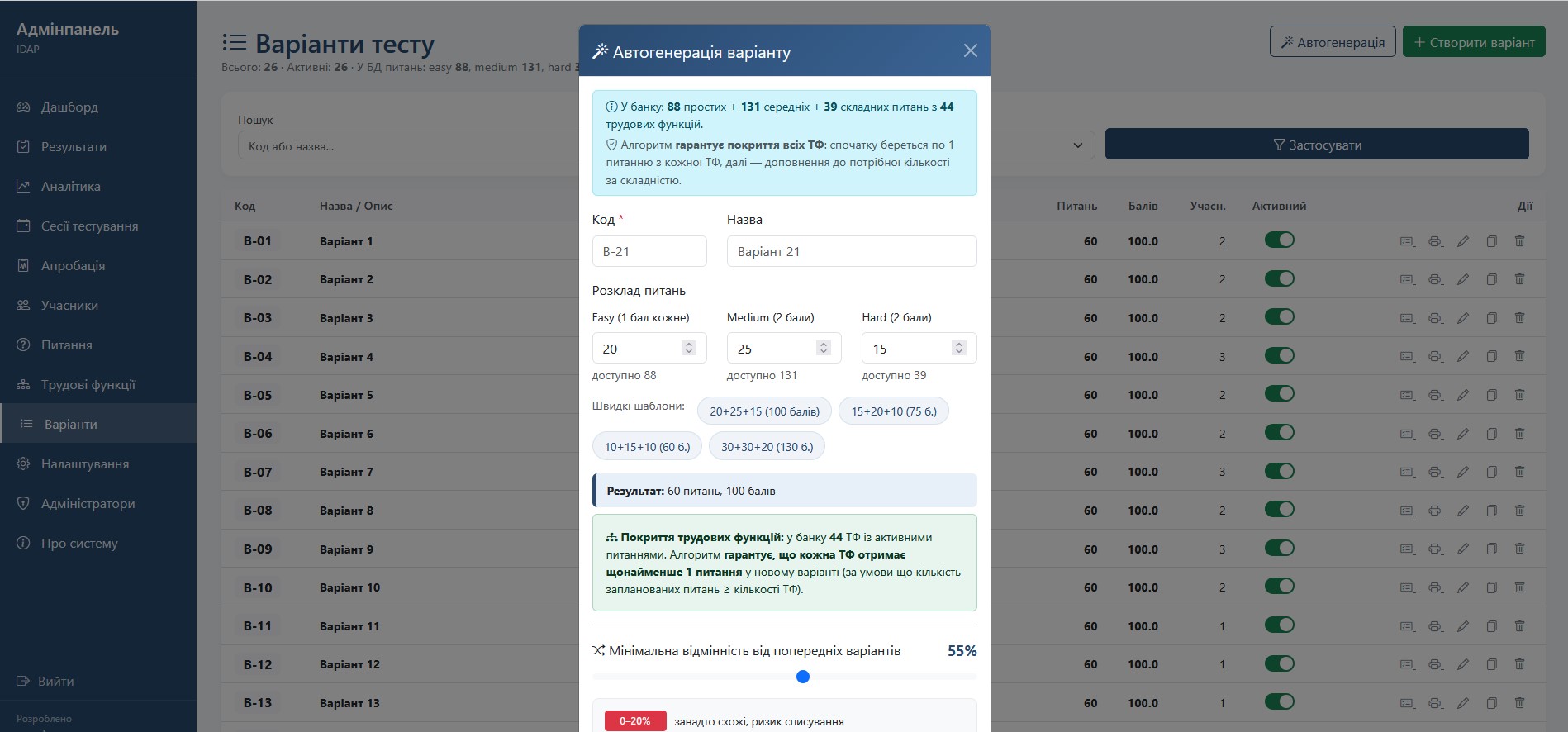
Create test variants manually or automatically — set the parameters and the system will generate the papers itself.
Images in questions
Support for question illustrations — diagrams, drawings, equipment photos, and process cards.
Flexible settings
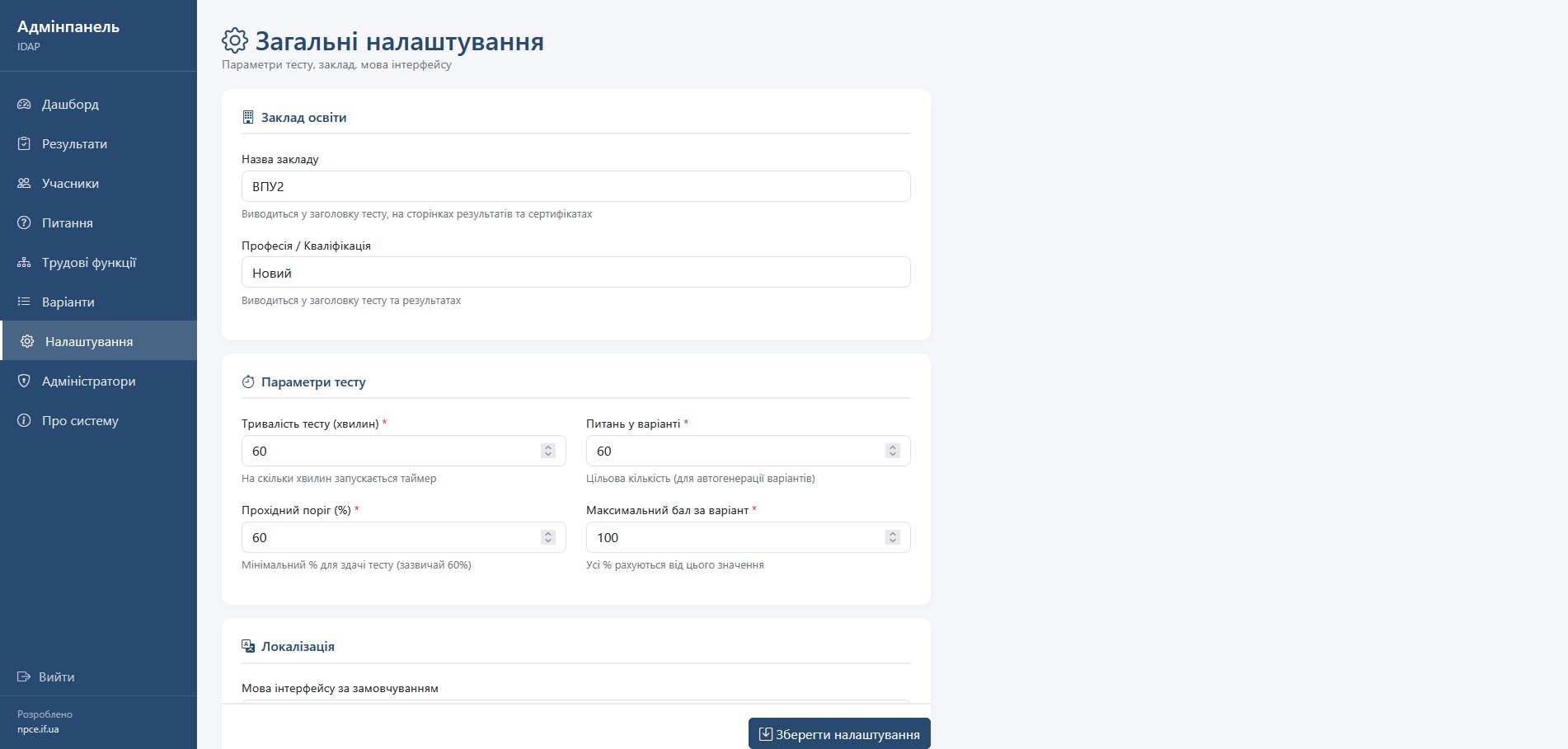
Configurable test duration, pass threshold in percentages, and maximum score for different qualification levels.
Analytics and reports
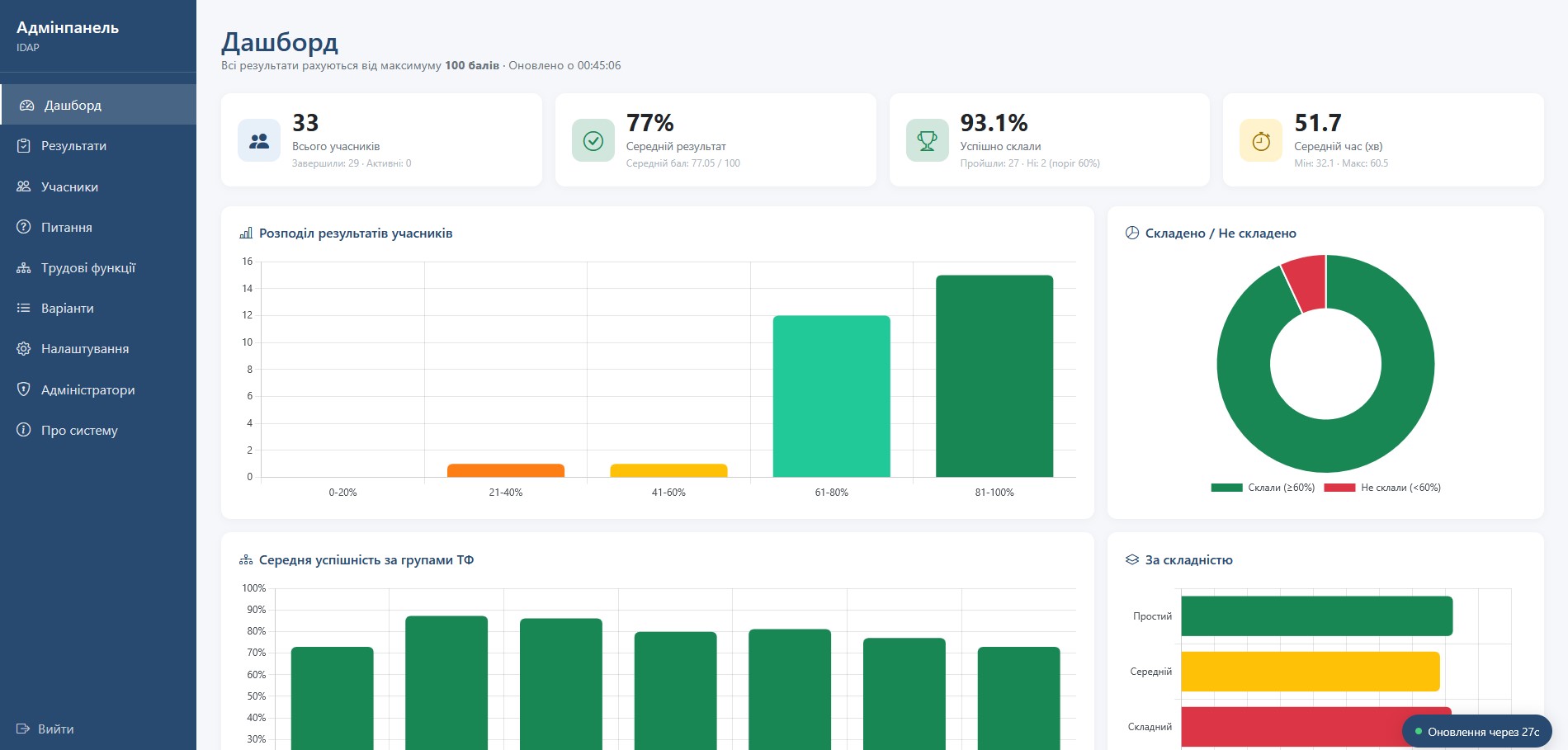
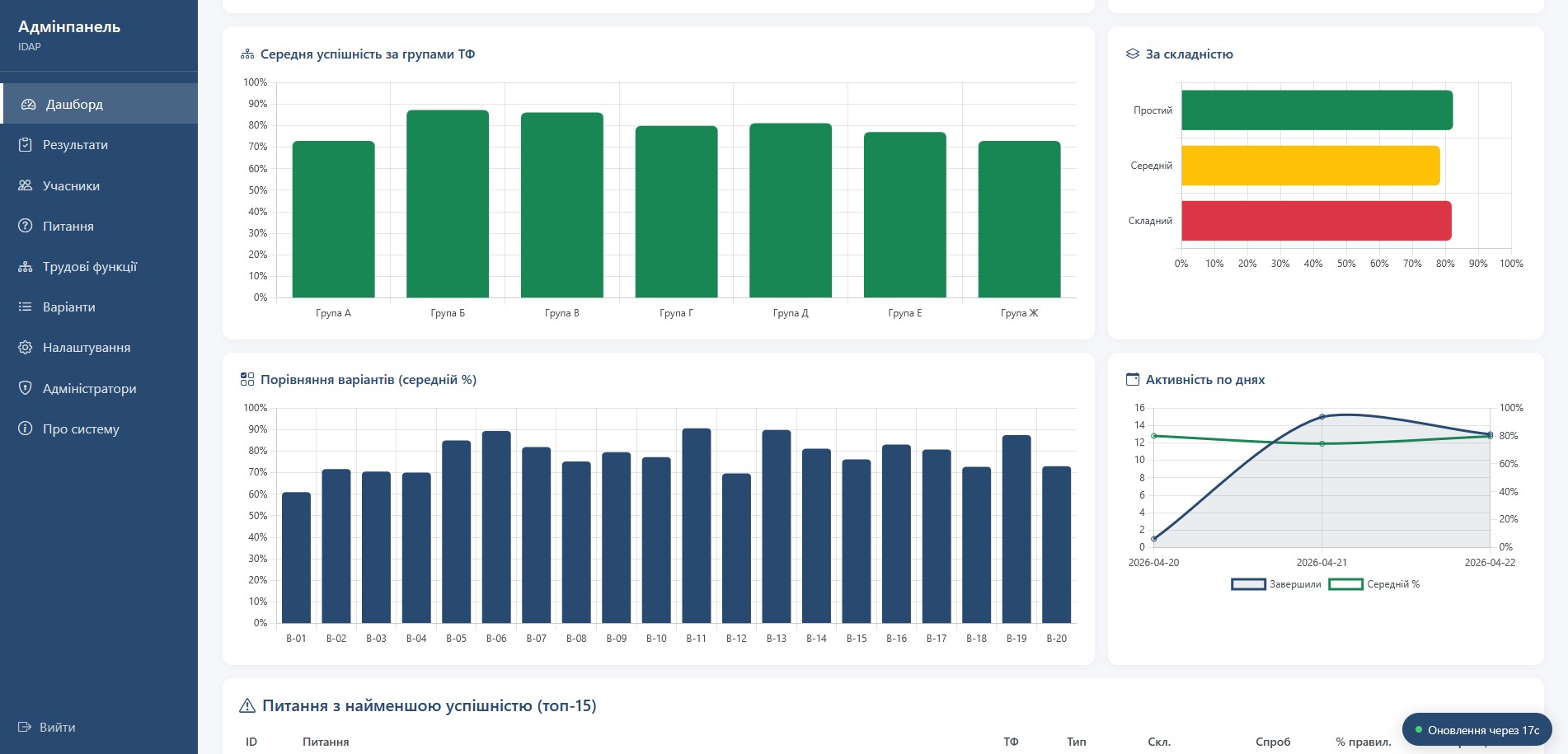
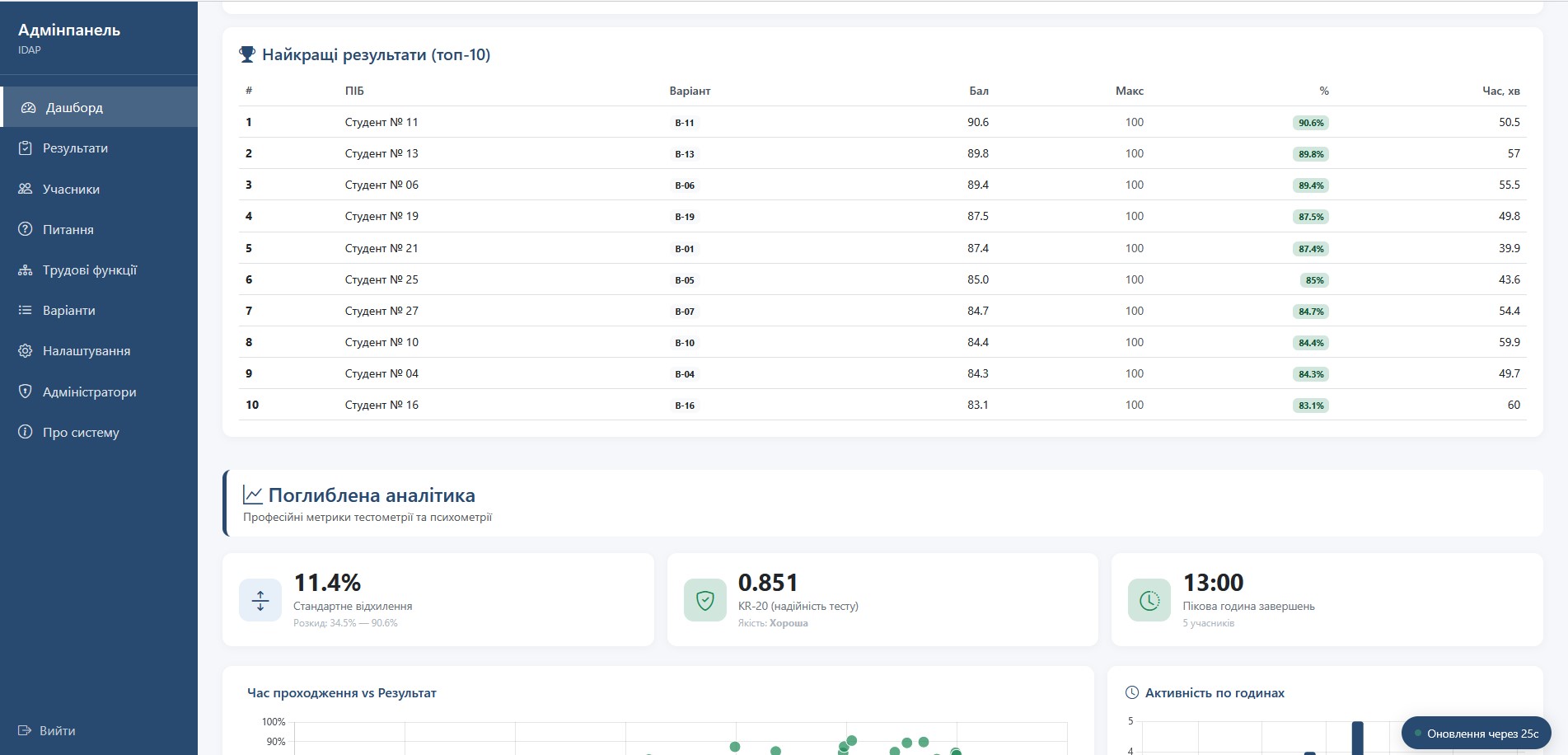
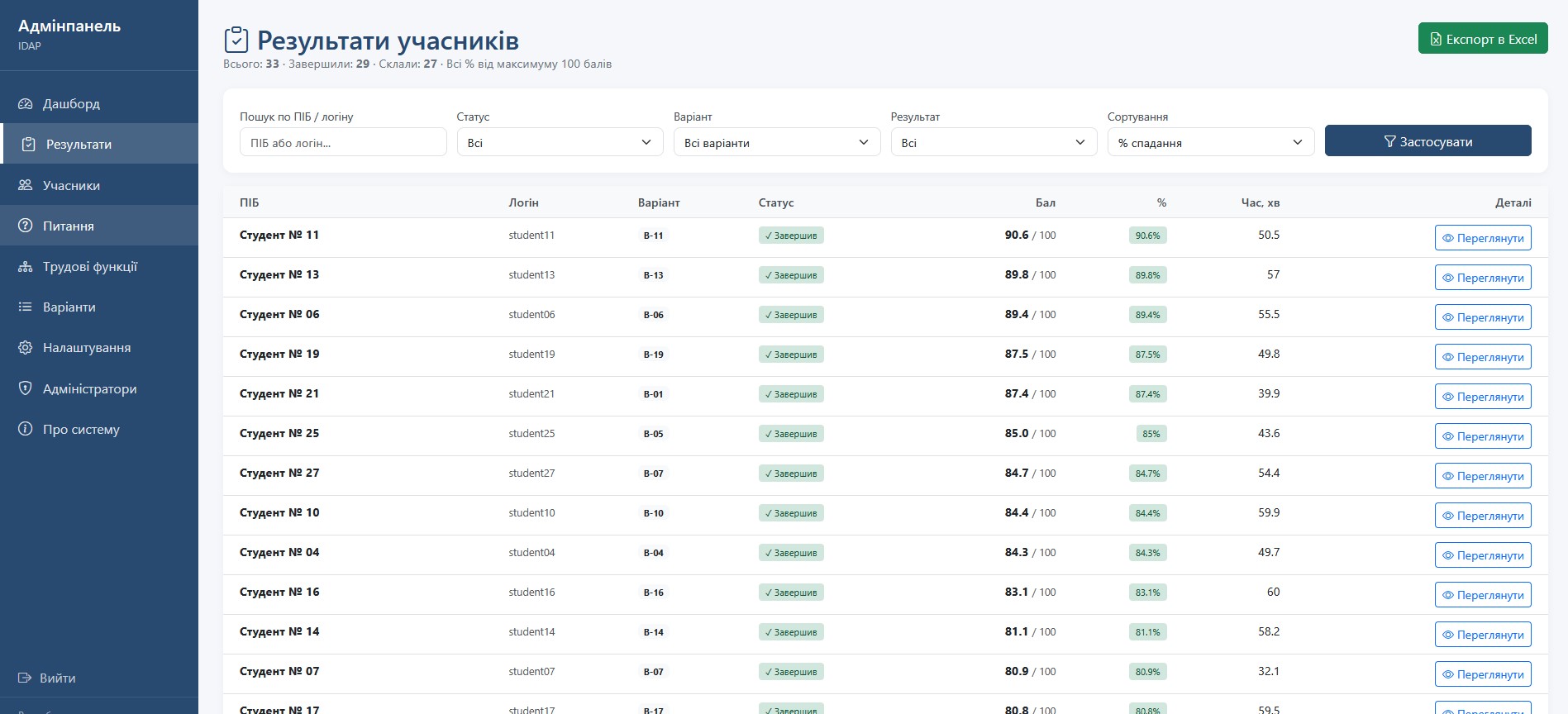
A dashboard with completion statistics, detection of difficult questions, and export of results to Excel.
Secure authentication
Separate accounts for each participant, bcrypt password hashing, and session timeout.
Multilingual interface
The interface is available in Ukrainian and English. The architecture allows adding other languages without changing the code.
XML import and export
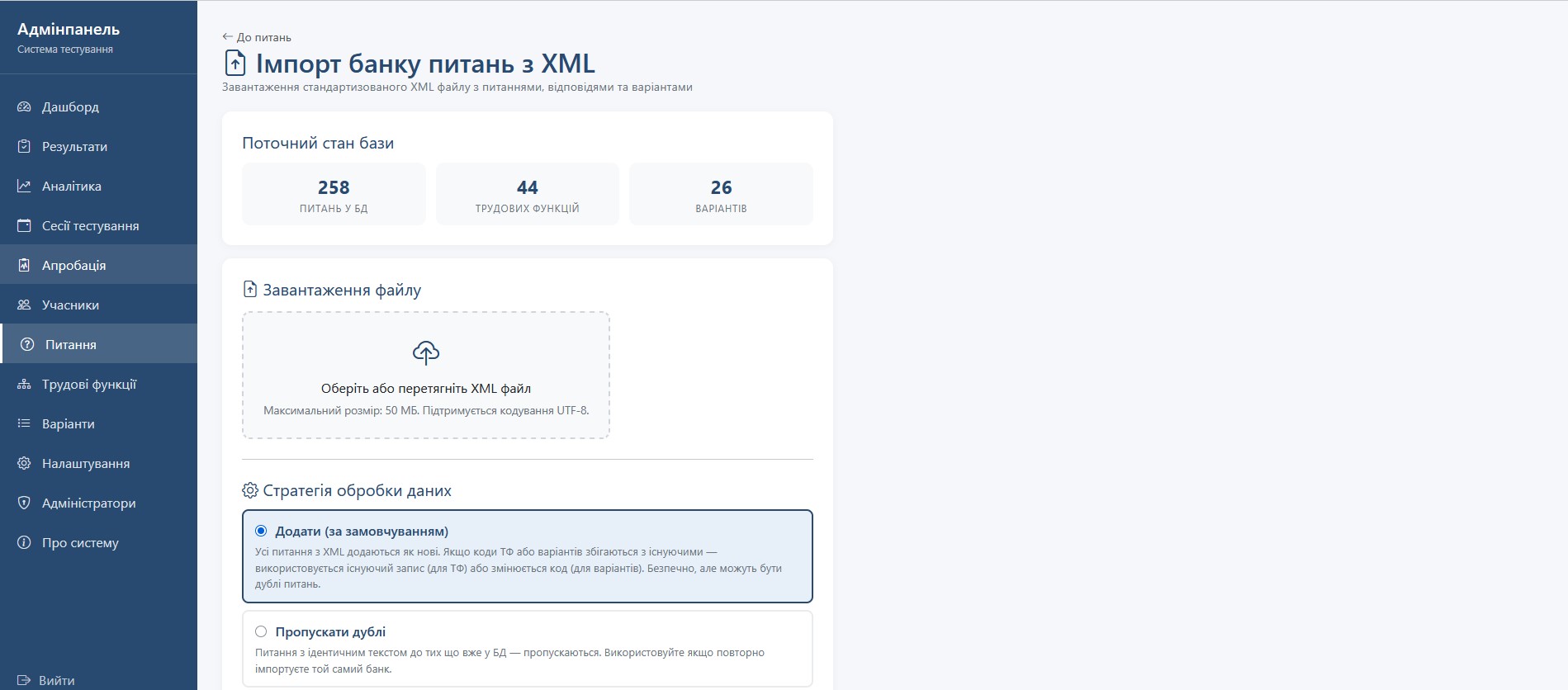
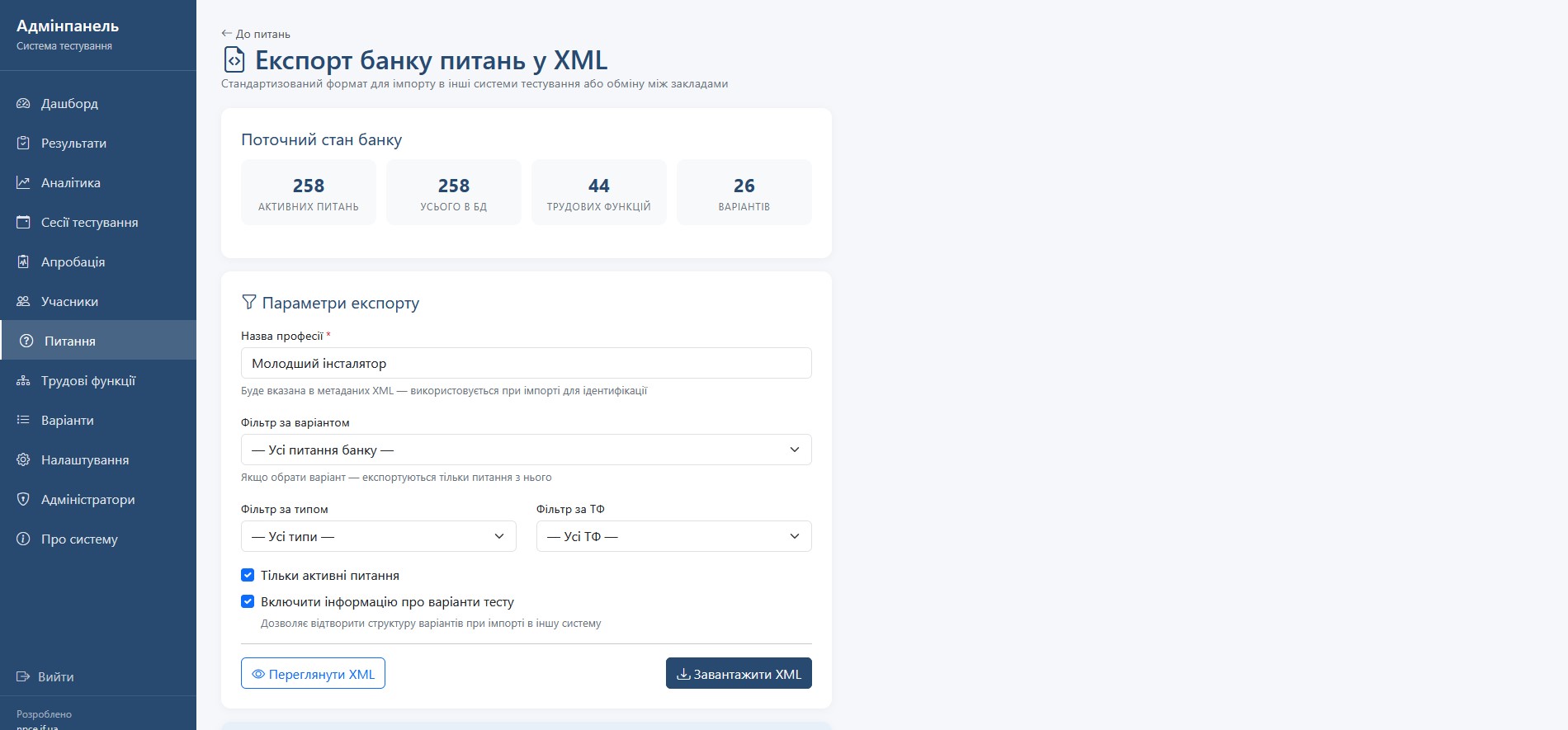
A standardized XML format allows institutions to exchange question banks, transfer content between instances, and create shared profession-based databases.
NCME variant analysis
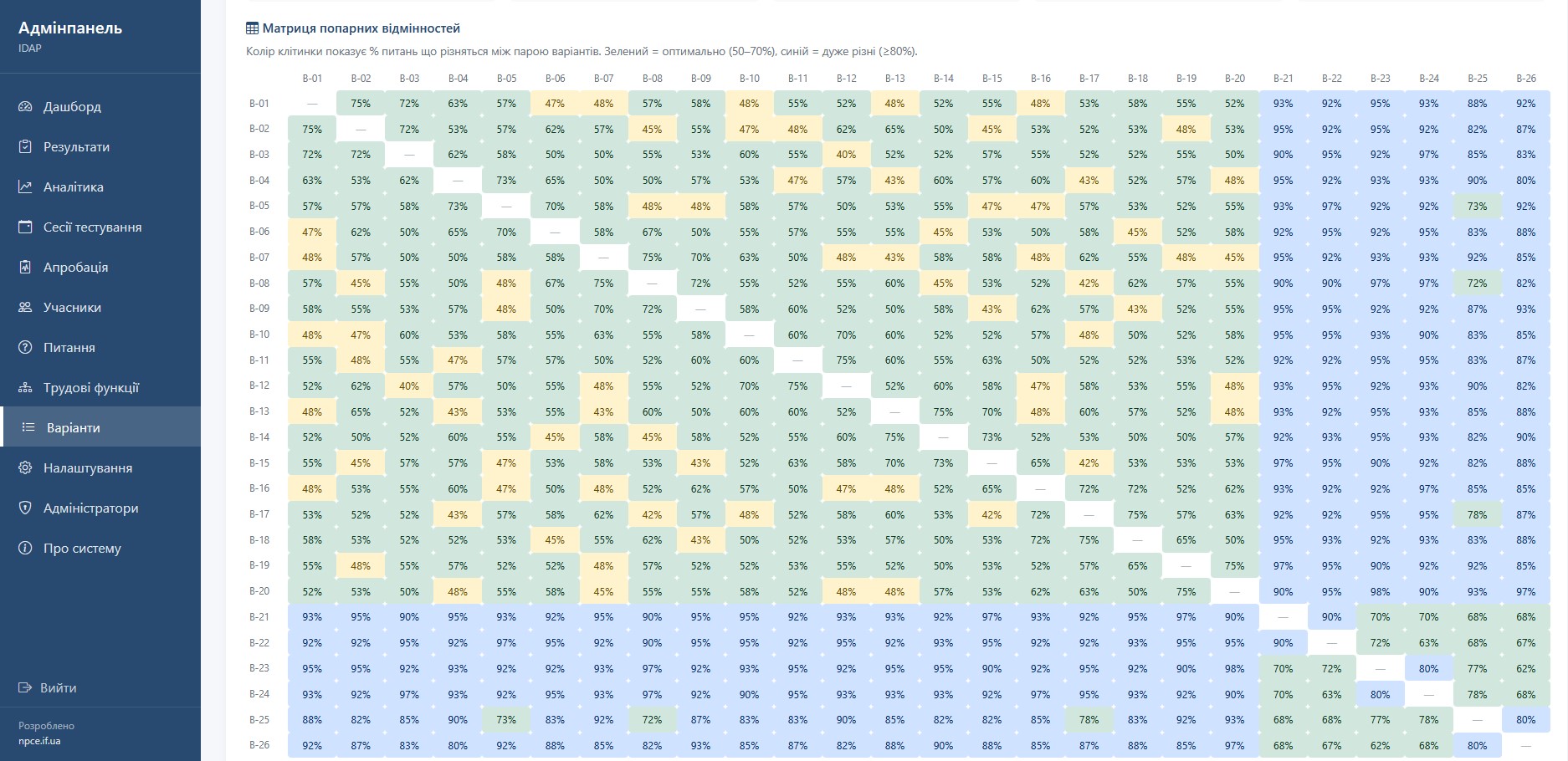
A pairwise-difference matrix with clear ranges (cheating risk, current, optimal, very different) and a target-difference slider for automatic generation.
Bloom's taxonomy
Six levels according to the revised 2001 taxonomy. Coverage within a test variant, participant gap analysis, separated from question type and difficulty.
Testing sessions
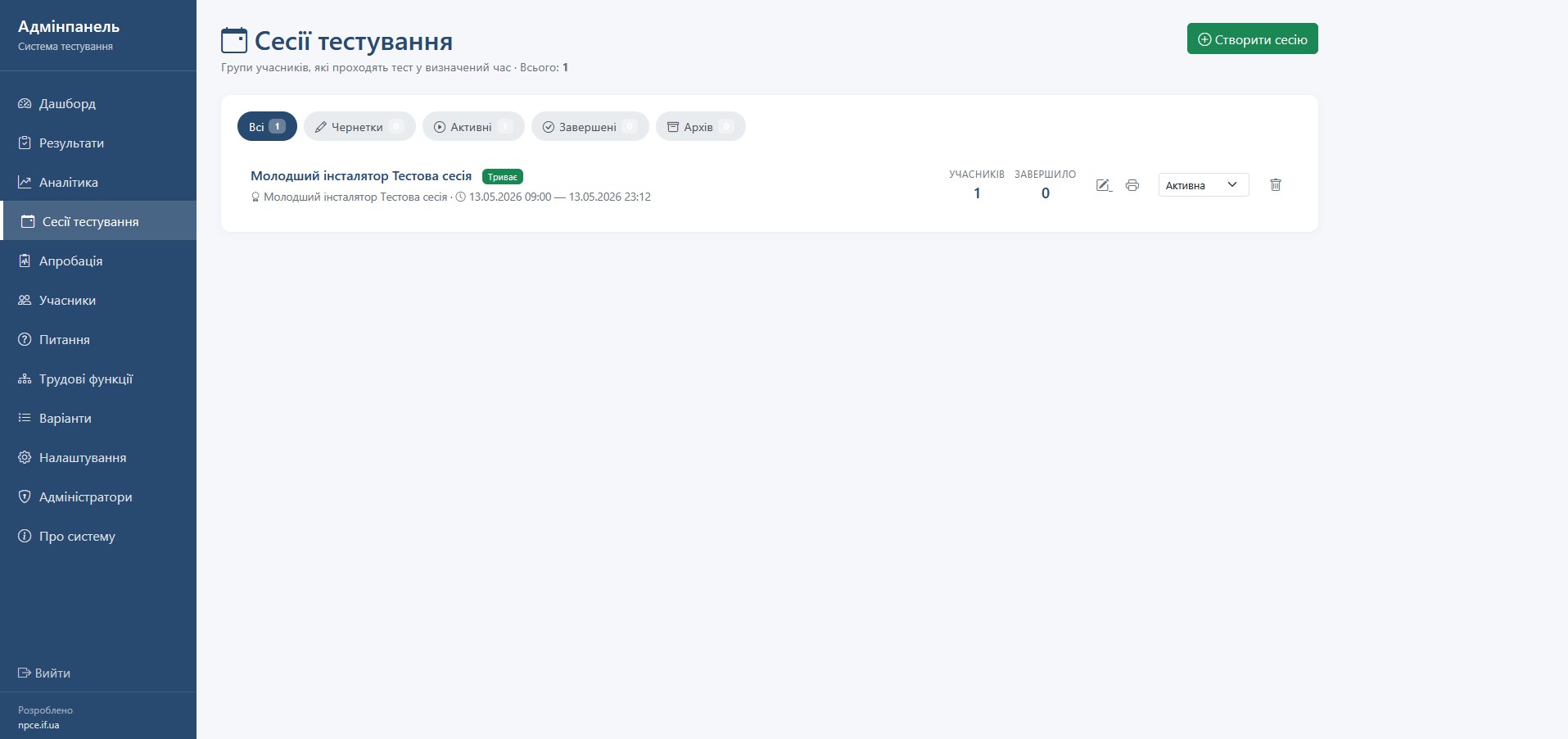
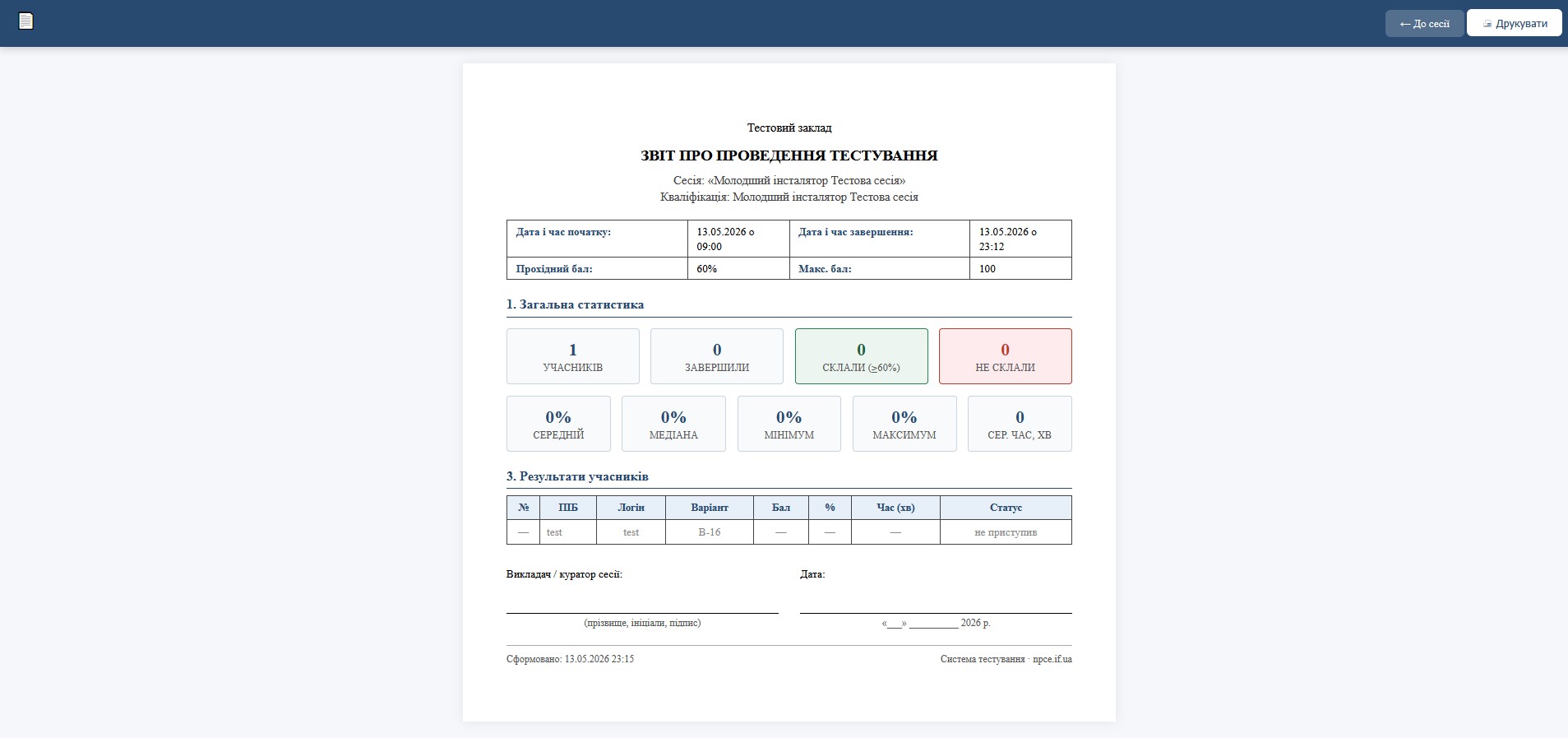
Create separate testing sessions, assign participants, configure dates, time, and access periods, and generate a final report based on completion results.
Audit log
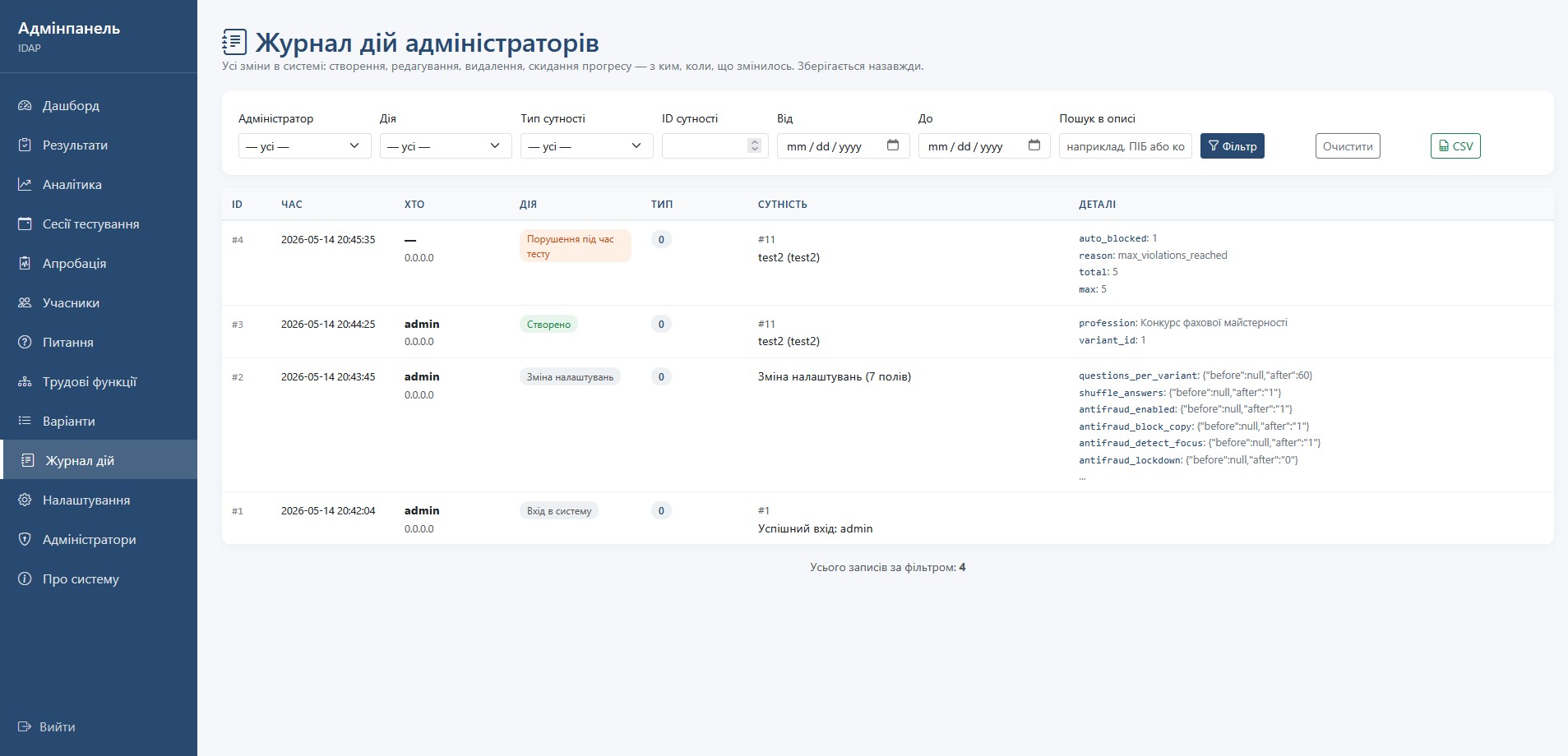
Full logging of administrator actions in the system: creating, editing, and deleting questions, answer options, labour functions, participants, administrators, and settings.
Anti-cheating
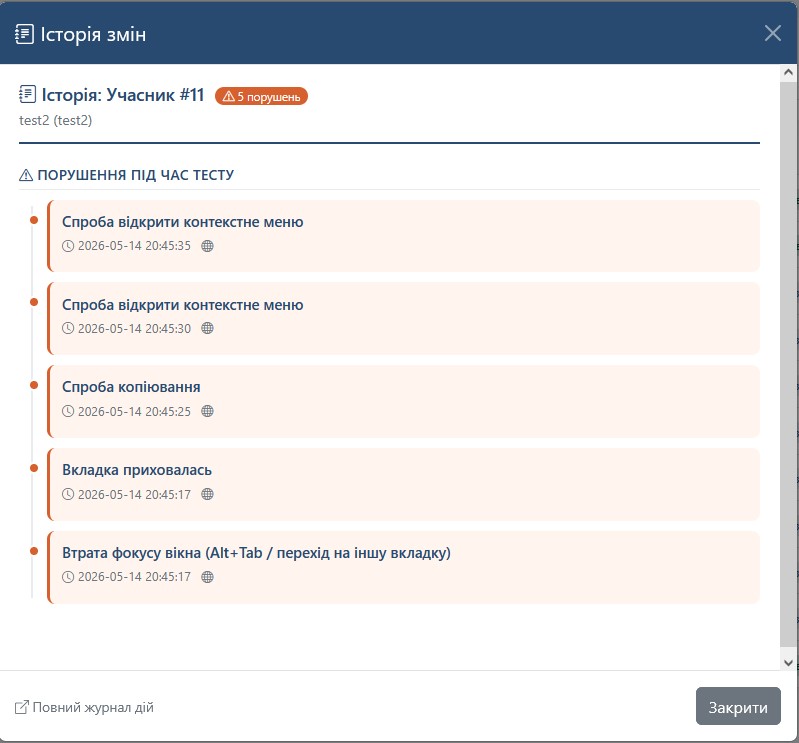
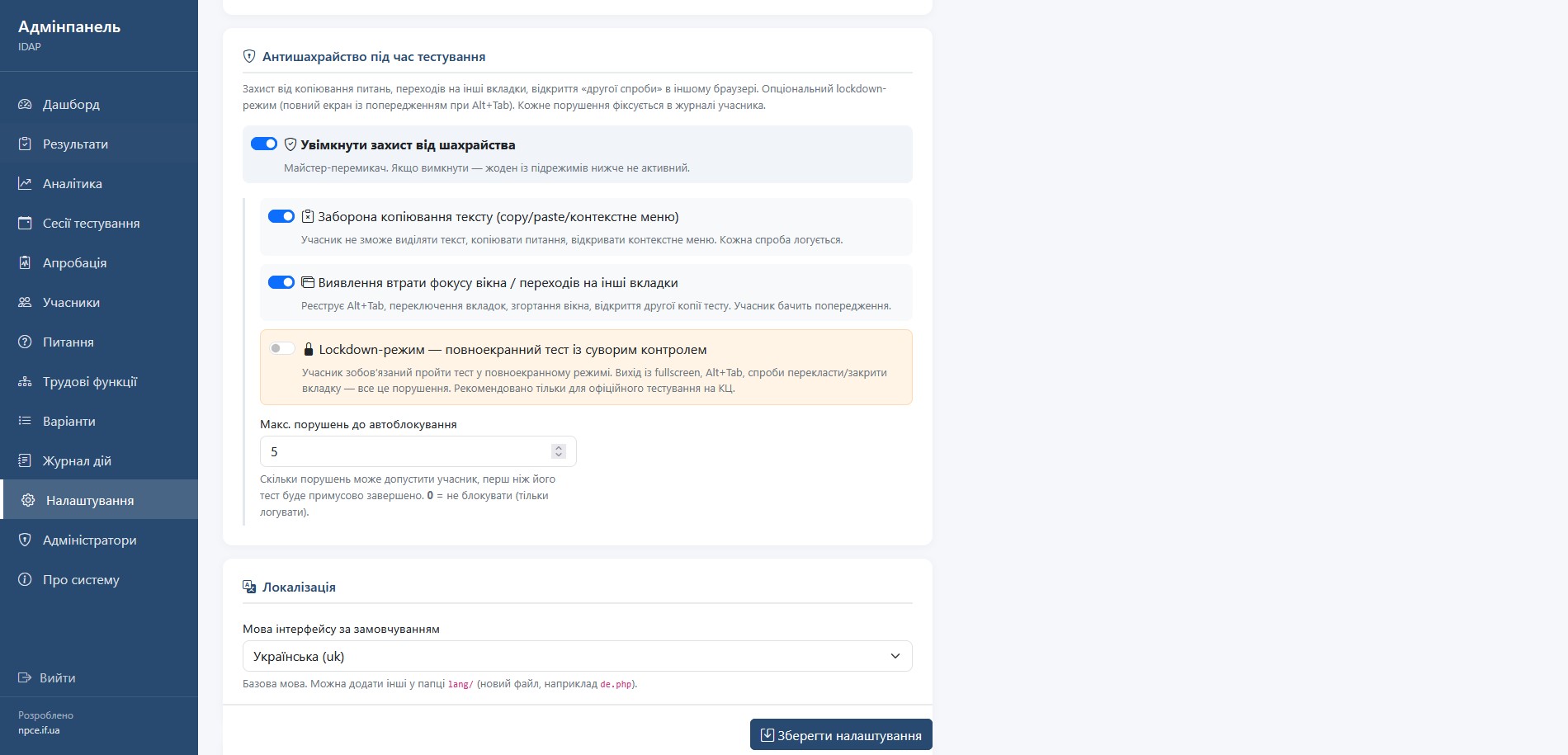
A testing integrity module with separate protection modes: disabling copy, paste, and the context menu; detecting focus loss, switching to another tab, or minimizing the window; and a lockdown mode with full-screen testing. If the set violation limit is exceeded, the test can be automatically completed.
Piloting module
Create piloting sessions, select participants, and automatically generate an A4 report with full psychometric analysis for the commission — ready for signing.
Professional analytics
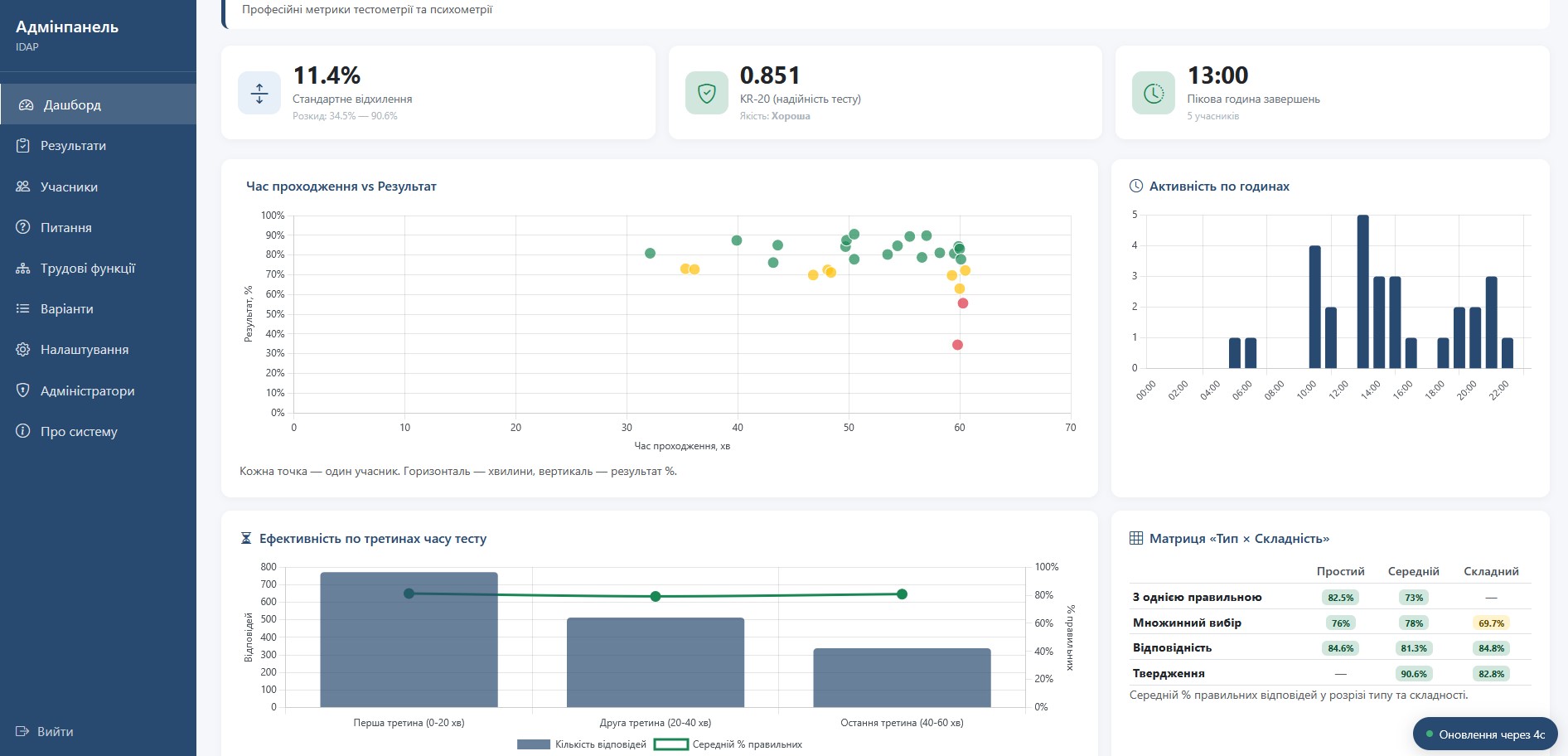
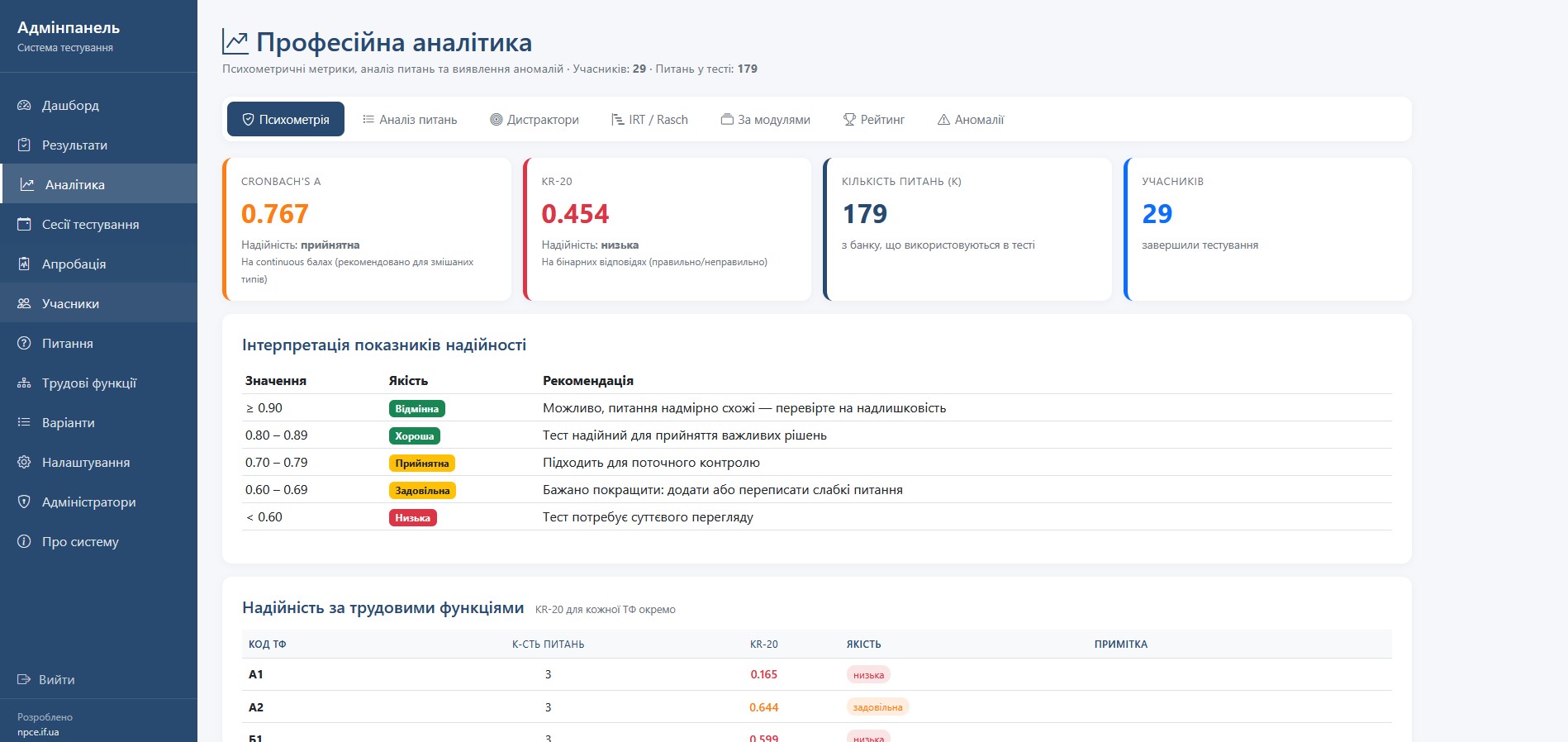
Cronbach’s α, KR-20, difficulty index p, discrimination D, distractor analysis, IRT/Rasch model, module-level reliability, anomaly and cheating detection.
Print test variants
Generate printable A4 test variants for paper-based testing, with a separate answer key matrix for the evaluator.
Time and efficiency analysis
Standard deviation of results, efficiency by thirds of time, and correlation between duration and score — for assessing fatigue and test validity.
Participant auto-generation
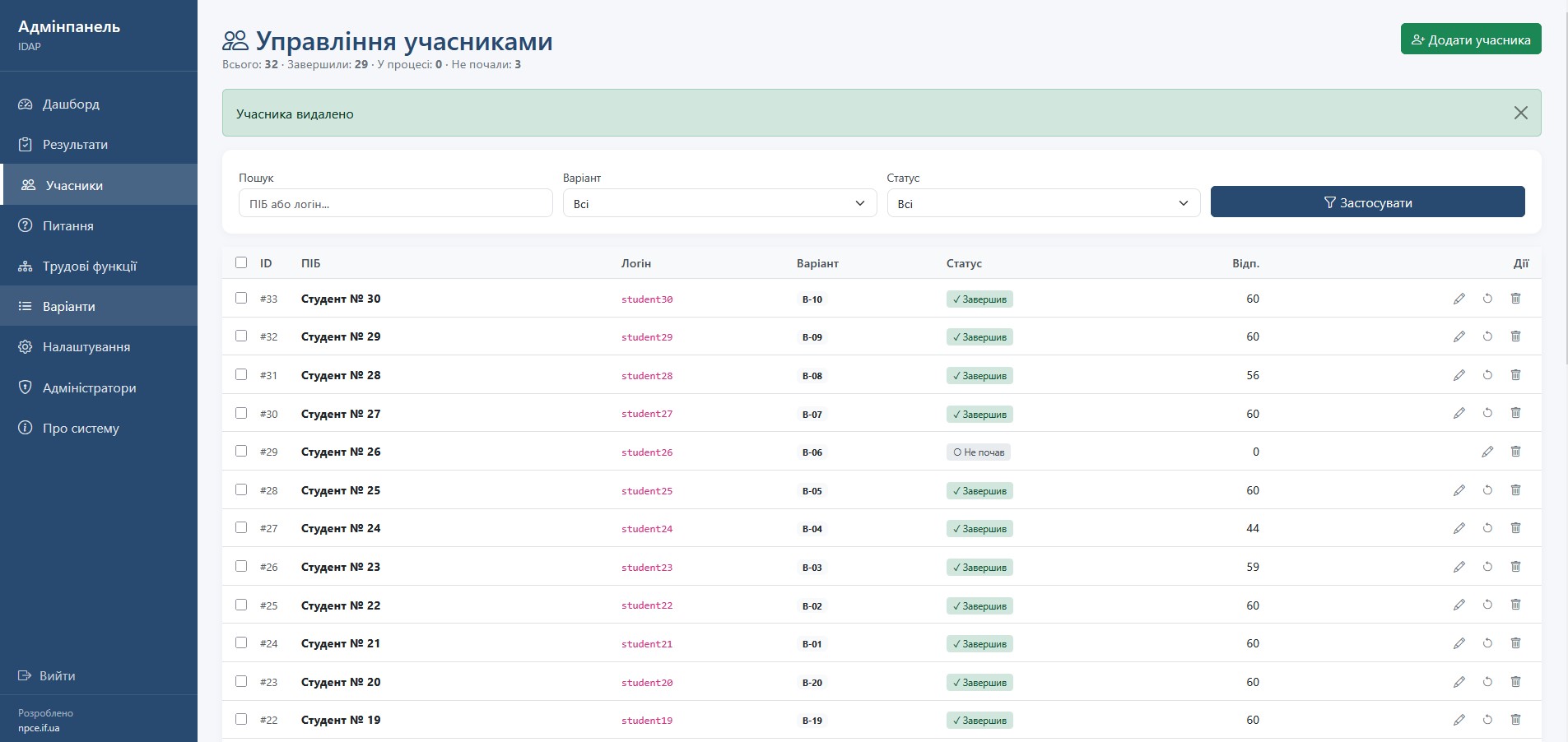
Bulk creation of accounts using the userXX/passXXX pattern with even round-robin distribution of variants. Export the list to CSV or print it for distribution.
Anomaly detection
Automatic detection of suspicious patterns: overly fast completion, identical answers among different participants, or an unusually high score in a short time.
KaTeX formulas
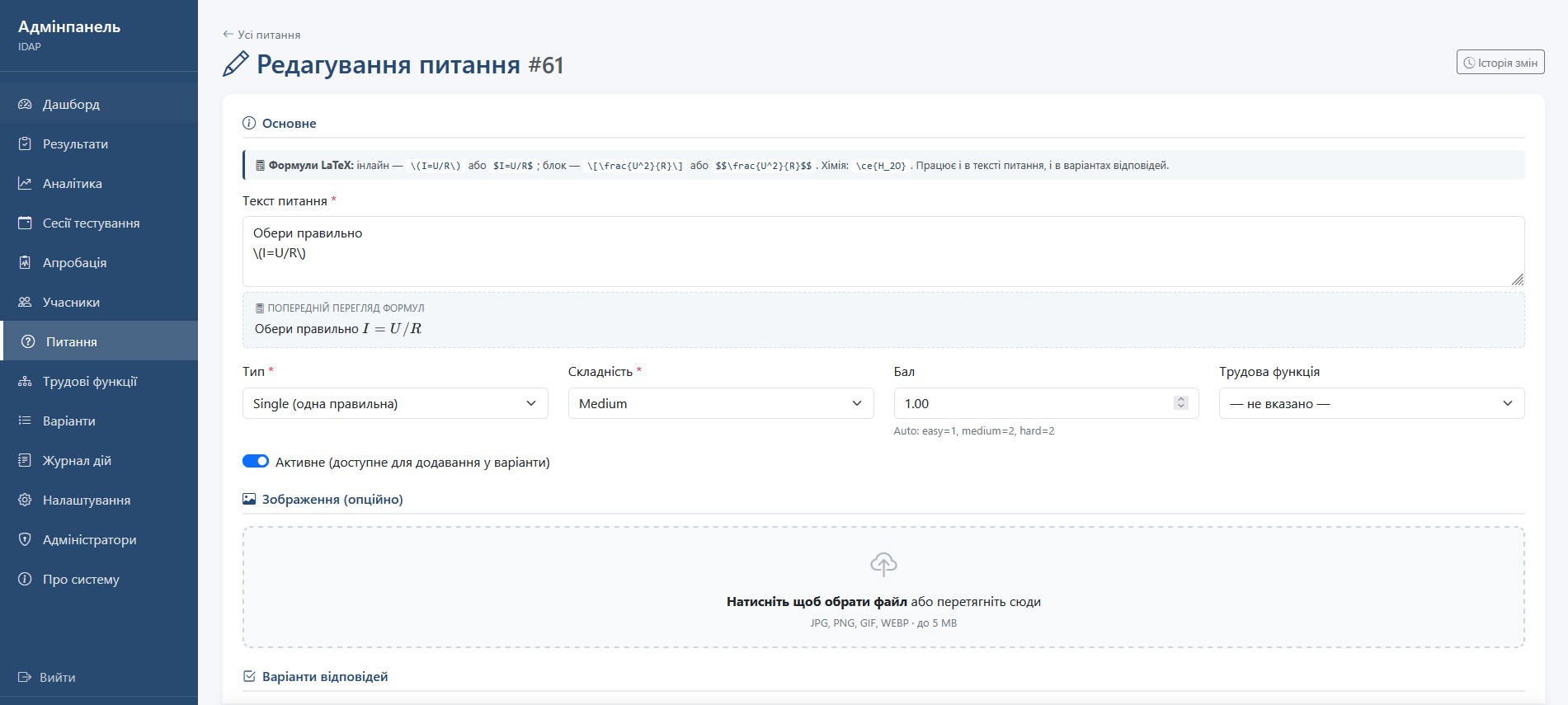
Support for inserting mathematical and technical formulas into question text and answer options using KaTeX. This enables correct display of electrical calculations, physics formulas, and other special notation without loss of rendering quality.
Supported question types
Six formats that cover most professional assessment needs.
Single correct answer
A classic multiple-choice question with several options, only one of which is correct.
Multiple correct answers
The participant selects all correct options. Partial points are awarded for partially correct answers.
Matching
Pairing items: term–definition, tool–purpose, diagram–component.
True / False
Binary evaluation of a statement. A fast way to assess basic knowledge.
Correct sequence (ordering)
Arranging stages, actions, or elements in the correct logical, technological, or chronological order.
Sentence blanks
A question type in which the participant fills two blank spaces in a sentence with the correct words, terms, or numbers.
How it works
Four stages — from entering the first question to receiving the results.
Content preparation
The administrator enters labour functions according to the professional standard and builds a question bank linked to them.
Variant formation
Test papers are created manually with a fixed composition or automatically according to predefined criteria.
Participant registration
Each learner receives an individual login and password and is assigned a specific test variant.
Result analysis
After completion, the system automatically calculates scores, assigns pass/fail status, and exports the record to Excel.
How to install
Five installer-wizard steps — no manual file editing required.
Environment check
The wizard automatically checks the PHP version, required extensions (mysqli, mbstring, gd), and folder write permissions.
Database connection
Enter the MySQL parameters — host, database name, user, and password. The wizard checks the connection and shows the result before you click “Next”.
Structure creation
Automatic creation of tables and initial settings. Progress is displayed step by step, reducing the risk of an interrupted installation.
Institution setup
Enter the institution name, profession, interface language, test duration, and pass threshold. All of these can be changed later in the admin panel.
Administrator creation
Create the main administrator account. After completion, the wizard is blocked by the install.lock file — rerunning the installer is impossible unless the file is deleted.
Who this solution is for
The platform is suitable for any institution that conducts structured assessment.
- Vocational education institutions
- Qualification centers and certification centers
- Sector-specific training and practical centers
- Corporate training departments
- Upskilling and retraining courses
Security and reliability
The platform was designed with modern web-security practices and the transparency requirements of qualification centers in mind.
System protection
- ✓ Password hashing All passwords, both for administrators and participants, are stored as bcrypt hashes — even if the database is compromised, passwords cannot be recovered.
- ✓ SQL injection protection All database queries are executed using prepared statements.
- ✓ XSS protection All data output to HTML is escaped using htmlspecialchars; user content is limited by field types.
- ✓ CSRF protection All admin-panel POST operations are performed within an authorized session with session ID regeneration on each login.
- ✓ Session timeout An administrator session automatically ends after 4 hours of inactivity.
- ✓ Brute-force protection A delay after failed authentication makes password guessing harder; all failed attempts are recorded in the audit log.
- ✓ Controlled reinstallation The install.lock file protects an already deployed system from accidental relaunch of the installation wizard.
Transparency and testing integrity
- ✓ Administrator audit log Every question change, option deletion, or participant-progress reset is recorded with full name, time, IP address, and complete before/after state. In case of an appeal, the full history is available in one click.
- ✓ Individual shuffling of answer options Each participant sees their own option order, deterministically based on their ID. Neighbors with the same test paper cannot simply tell each other that “B is correct”.
- ✓ Protection from copying and tab switching An optional mode blocks copy/paste and the context menu, and records attempts to leave the test window (Alt+Tab, another tab) with a warning to the participant.
- ✓ Full-screen lockdown mode For official testing, fullscreen mode is mandatory with forced return after F11/Esc. Exceeding the violation limit results in automatic test completion with a log entry.
- ✓ Answer-state preservation for appeals For each answer, the system stores the option order seen by the participant and the correct order at the time of answering — enabling exact reconstruction of the participant’s screen during an appeal.
- ✓ Variant-based access control The participant sees only their own variant. After completion, retaking the test is impossible unless an administrator explicitly resets progress, which is also logged.
DevTest module — a test question authoring system
DevTest is a standalone application that works “upstream” of the testing system: experts create questions, a methodologist approves them, and the finished bank is exported in a format compatible with IDAP.
One process — from draft to an approved question bank
The installation wizard deploys DevTest in a minute, and questions then go through a single managed approval cycle:
draft → under review → revision → approved → XML export
.
Three roles with separation
The administrator creates accounts and assigns experts to moderators; the methodologist-moderator reviews; the expert creates questions. Each sees only their own area.
Editor for six question types
Single and multiple choice, matching, true/false, sequence, fill-in-the-blanks — with image upload and live preview.
Review by the methodologist
The methodologist approves, returns for revision, or rejects a question. A discussion thread between the expert and the methodologist keeps the dialogue right on the question page.
Expert groups
Each moderator leads several assigned experts and sees only their questions. Experts in one group share a common bank but edit only their own.
XML and CSV import
Bulk filling of the bank from question_bank files, including reverse import from quiz_system, and CSV for quick entry. Work functions are created automatically.
Export to the testing system
Approved questions are exported to question_bank 1.0 XML and imported directly into quiz_system. Compatibility is verified by an end-to-end test.
Statistics and bank readiness
Distribution of questions by type, difficulty, and Bloom’s levels, the productivity of each expert, coverage of work functions, and a completeness check of the bank before export.
Security
Passwords are stored as bcrypt hashes, all forms are protected with CSRF tokens, and login has rate limiting against password brute-forcing.
TestHub module — multi-instance control center
TestHub adds a central master panel to IDAP for managing multiple independent instances of the testing system within one educational institution.
One panel — many separate testing environments
The master panel
testhub/
works as a single control center, while each test remains isolated in its own database and configuration file.
Institution master panel
testhub/
is shared across the whole institution and has its own registry database for storing the list of tests, settings, and service data.
Test administration
Administer tests from one panel: edit, archive, and delete.
Each test has a separate database
Each testing instance runs in its own database. The existing testing-system code does not change — a separate
config.php
.
One-click test installation
Connects to an empty database, deploys the full schema, seeds the A–G labour-function directory, and creates the first administrator.
SSO bridge without repeated login
Clicking “Open” in the master panel automatically authorizes the administrator in the required instance without entering the password again.
Consolidated analytics
General statistics across all tests at once: number of participants, passed count, pass rate, and average score.
Security
All passwords are stored as bcrypt hashes — even if the database is compromised, passwords cannot be recovered.
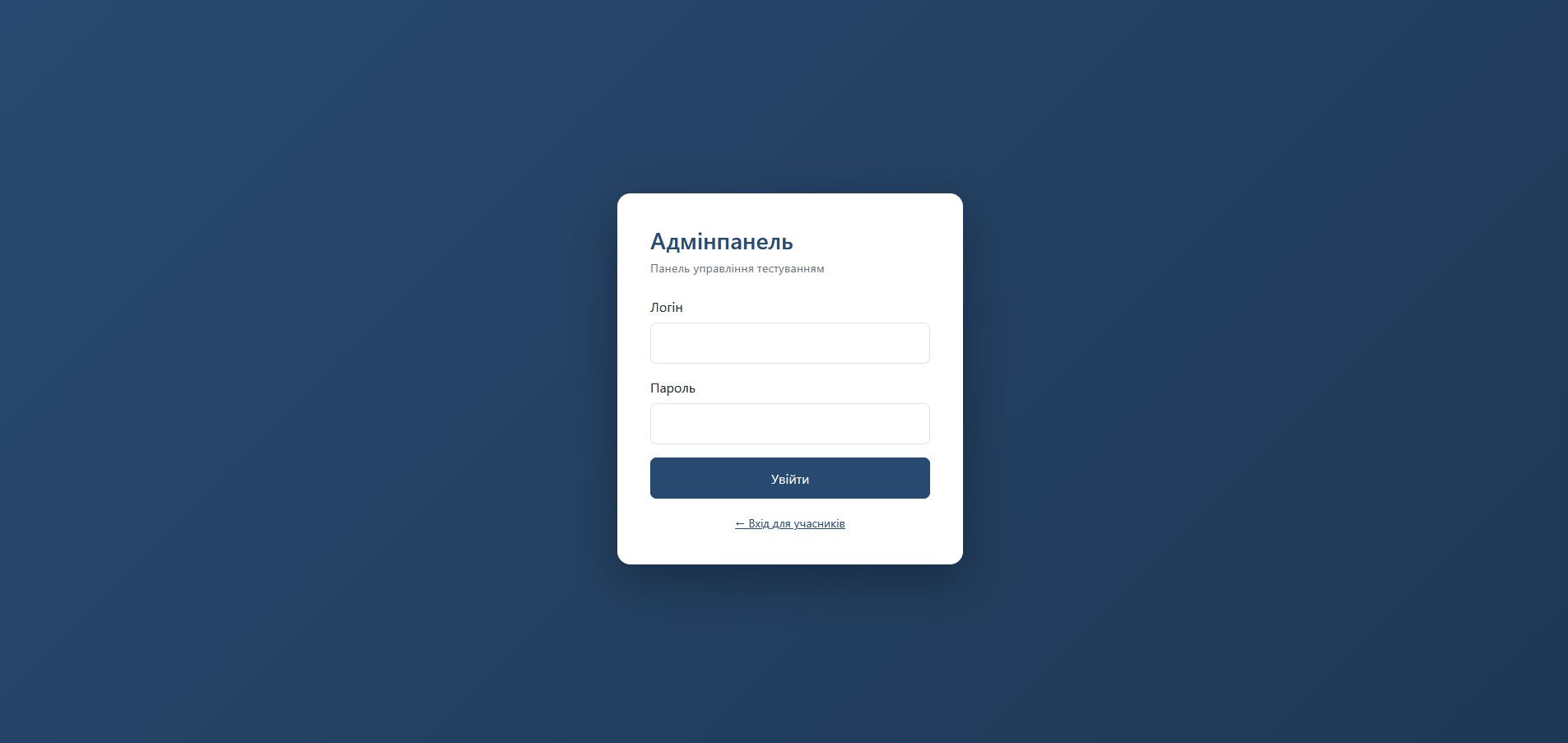
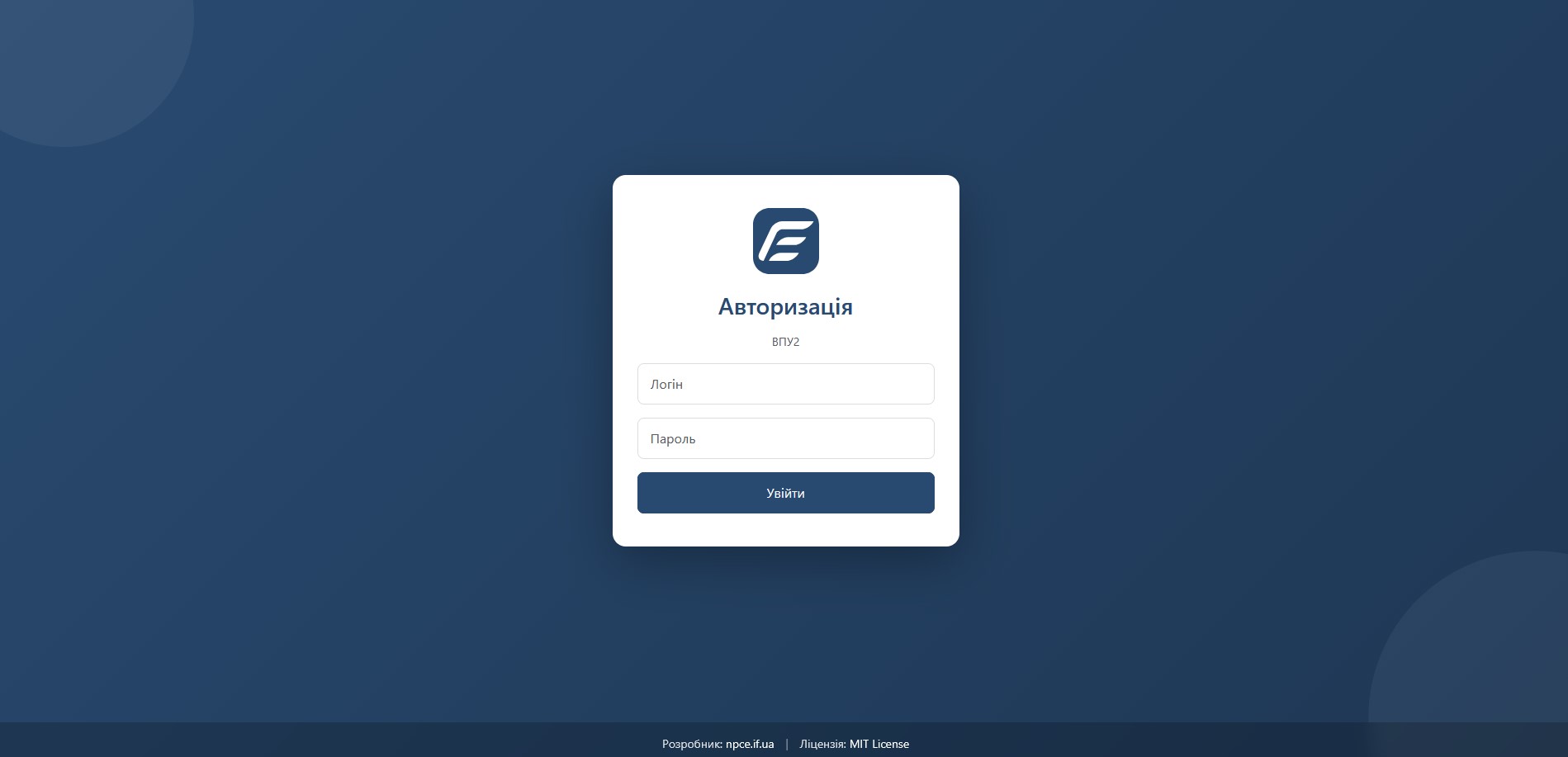
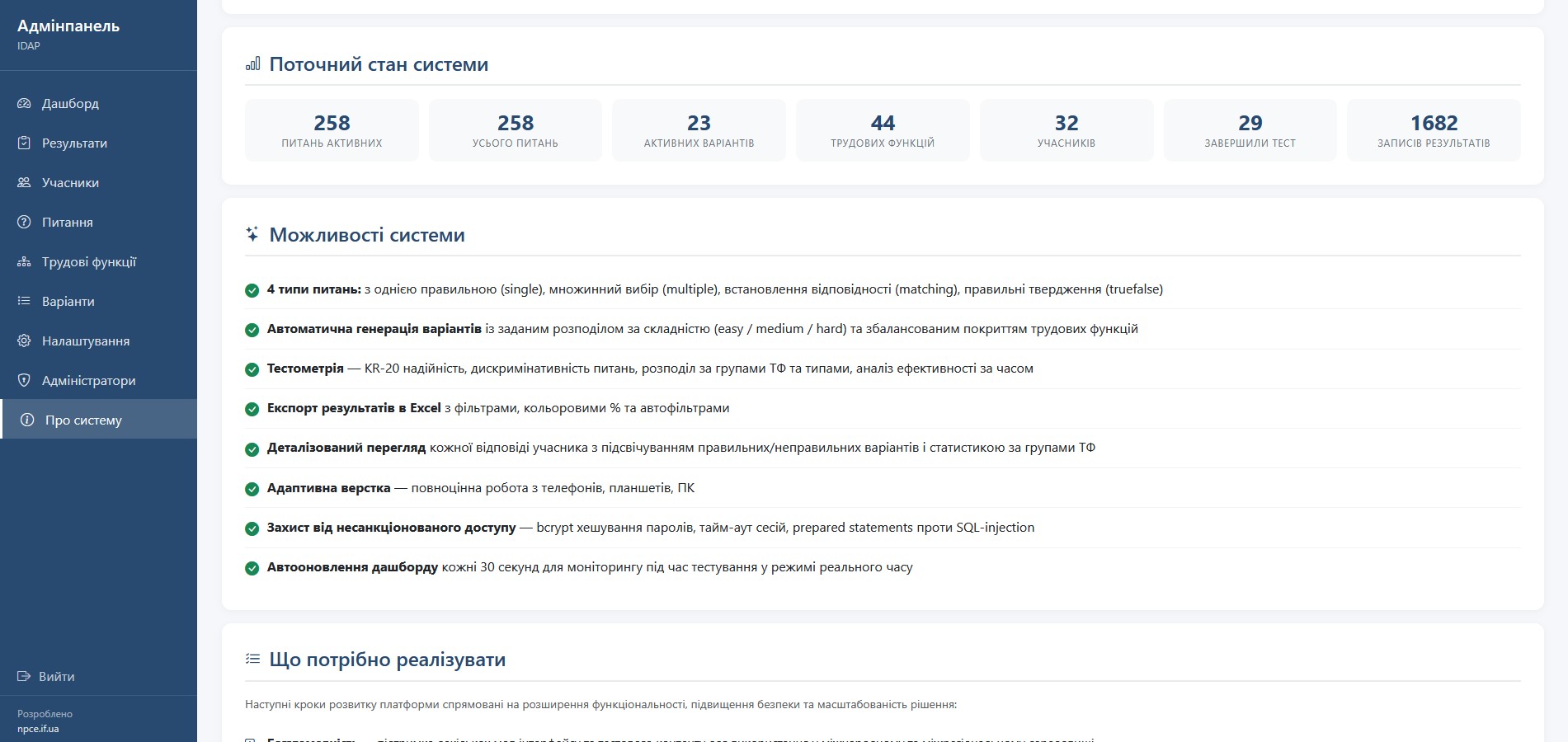
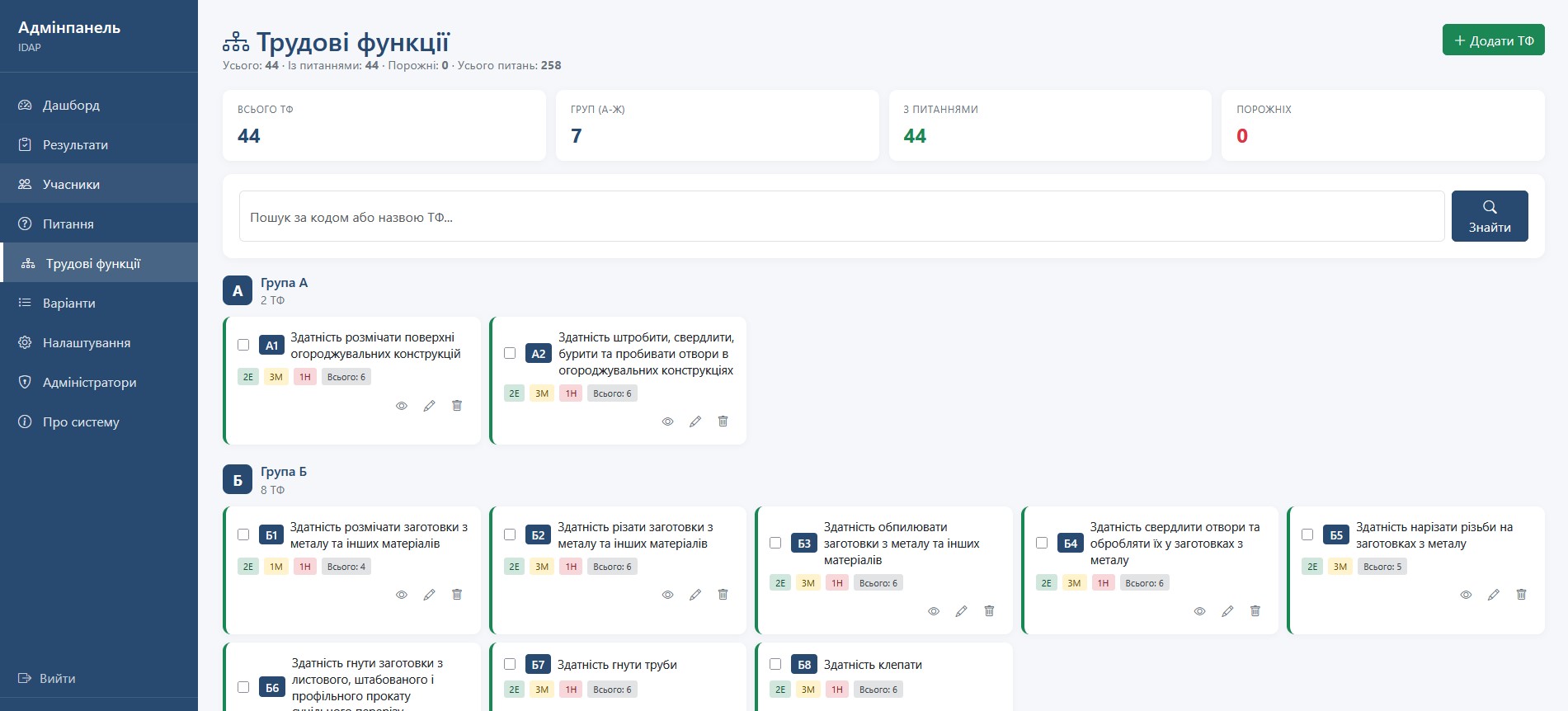
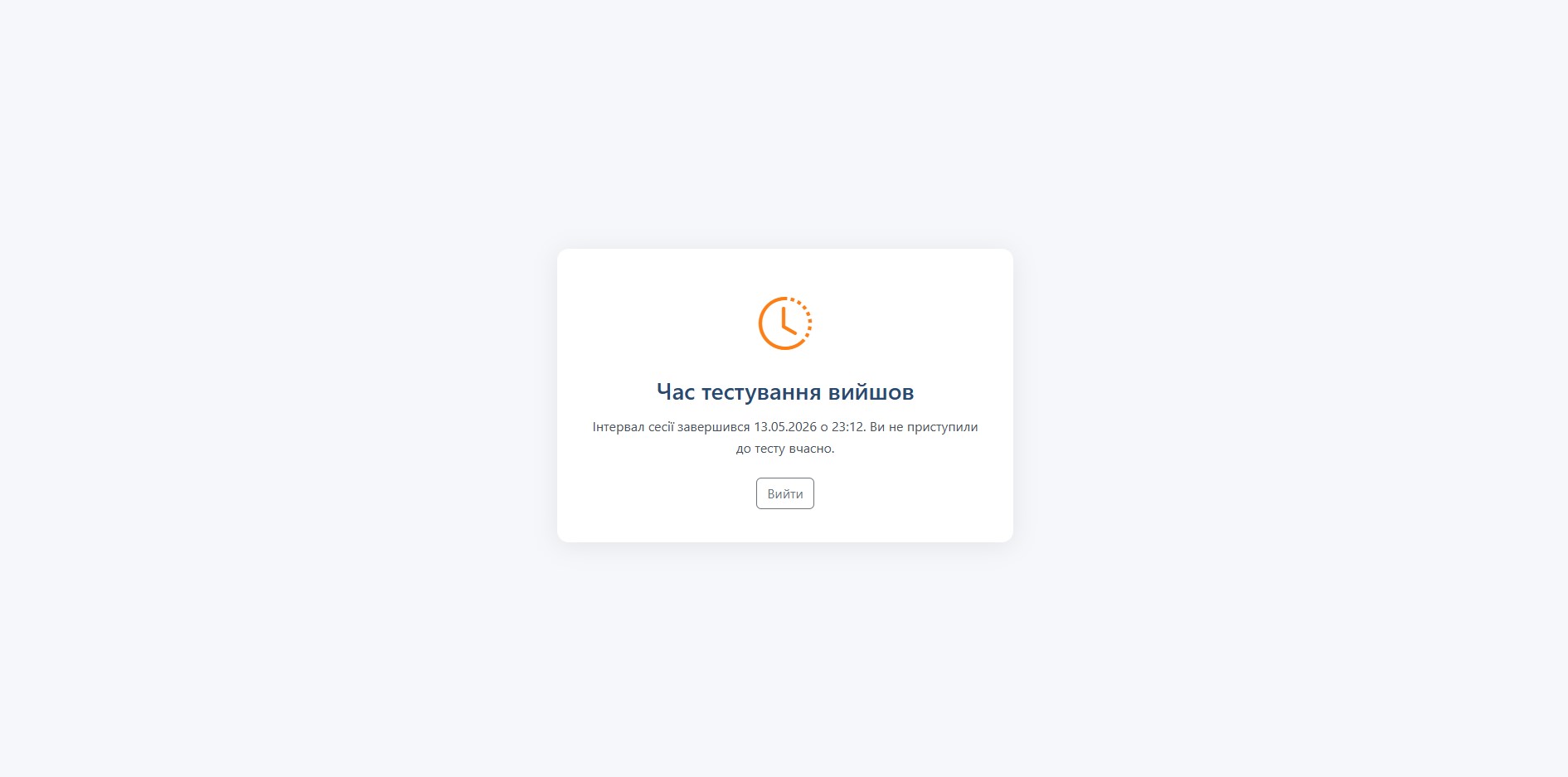
System screenshots
Platform interface: admin panel, testing, analytics, and management.

System demo
A fully functional demonstration of the IDAP platform in read-only mode. Create a user, take a test, and review the results analytics — without registration or installation.
Administrator login
idap.org.ua/demo/admin/admindemo2024Full view of all sections: question bank, variants, job functions, sessions, results, psychometric analytics, and the audit log.
Participant login
idap.org.ua/demo/login.phpstudentstudentA ready-made account with a short test (Express variant, 10 questions). Optionally, you can create your own participant in the admin panel.
Demo mode limitations
- Creating users
- Adding users to a test session
- Viewing, printing, and exporting all data
- Changing system settings
- Managing administrators and passwords
- Creating and editing test sessions
- Creating, editing, and deleting questions
- Changing job functions and variants
- Importing the question bank (XML)
The system is automatically restored to its initial state every 12 hours — all changes made will be reset.
Technical specifications
Runs on standard LAMP/LEMP hosting. A dedicated server is not required for deployment.
Backend
PHP 7.4+
Database
MySQL 5.7+ / MariaDB 10.3+
Frontend
Bootstrap 5.3
Encoding
UTF-8 (utf8mb4)
Open-source dependencies
The system is built on proven open-source libraries and frameworks. The dependencies use MIT-compatible licenses that allow commercial use.
\ce{H_2SO_4}, reaction equations.
Development contributors
IDAP is the result of collaboration among specialists from different fields.
System architecture, backend (PHP/MySQL), frontend, admin-panel interface, localization.
Labour-function structure, assessment criteria, adaptation.
Labour-function structure, assessment criteria, adaptation.
Module structure, assessment criteria, adaptation.
Localization, assessment criteria, adaptation.
Labour-function structure, assessment criteria, adaptation.
Labour-function structure, assessment criteria, adaptation.
Assessment criteria, adaptation.
Advanced analytics, assessment criteria.
Advanced analytics, information support.
Field testing, advanced analytics, assessment criteria, piloting.
Field testing, advanced analytics, assessment criteria, piloting.
Field testing, design.
Frontend, admin-panel interface, localization.
Backend (PHP/MySQL), localization.
Partners
The development and implementation of IDAP takes place in cooperation with institutions and organizations that share the idea of open digital assessment tools.

of the Ivano-Frankivsk Regional State Administration
The Department's mission is to ensure the digital transformation of the region by implementing state policy in the areas of digital development, e-governance, cyber protection, telecommunications, IT-industry growth, and the introduction of modern electronic services for citizens, business, and public authorities.

DTEK Academy is an open corporate university created to develop future leaders, enhance professional skills, and expand opportunities for both DTEK Group employees and external clients.

Hosting Ukraine is a leading Ukrainian hosting provider with more than 20 years of experience, operating on the market since 2006. The company owns its own data center in Ukraine and ensures uninterrupted website operation even under the most challenging conditions.

UALinux LLC is a provider of advanced IT solutions that combines global standards with national cybersecurity requirements in projects of any level. Its goal is to create comprehensive, high-tech solutions that shape the future. The company implements not only IT technologies but also trains users of any level — from beginners, helping them work confidently with Linux both in everyday life and in the office environment, to highly qualified specialists, for the expert management of modern telecommunications and information systems.

The Educational and Methodological Office of Vocational Education in the Ivano-Frankivsk Region is a hub of methodological work among the vocational education institutions of Prykarpattia. It provides organizational and methodological support for the training of skilled workers in line with state standards, the introduction of a new generation of state vocational education standards, and modern information and communication technologies in the learning process.

The Educational and Methodological Center of Vocational Education in the Volyn Region is a state institution that provides scientific, methodological, and information support for the development of vocational education in the region. The center coordinates the work of methodological sections, organizes professional development for their members, and holds seminars, conferences, and competitions of professional and occupational skill. Key areas of its work include the introduction of modern educational technologies, updating the content of vocational training in line with labor-market needs, the development and review of educational and methodological materials, and support for the innovative activity of vocational education institutions of the Volyn Region.

The Educational and Methodological Center of Vocational Education in the Luhansk Region provides methodological and information support for the educational process in vocational and pre-higher professional education institutions of the Luhansk Region. Its priority areas are supporting education quality amid modernization, creating conditions for continuous professional development of teachers, and studying and implementing progressive pedagogical experience and production technologies. Separate areas of activity include monitoring studies of institutions, innovation, and publishing activities.

The PROMTECH Initiative helps businesses solve the shortage of qualified workers in the most in-demand fields by offering fast and effective 6-week professional training adapted to the needs of the enterprise.

ZAXIDNA.PRO creates not just websites, but powerful tools for attracting customers, increasing sales, and scaling a business online.
Open to new partnerships. Write to us at info@idap.org.ua.
IDAP Community
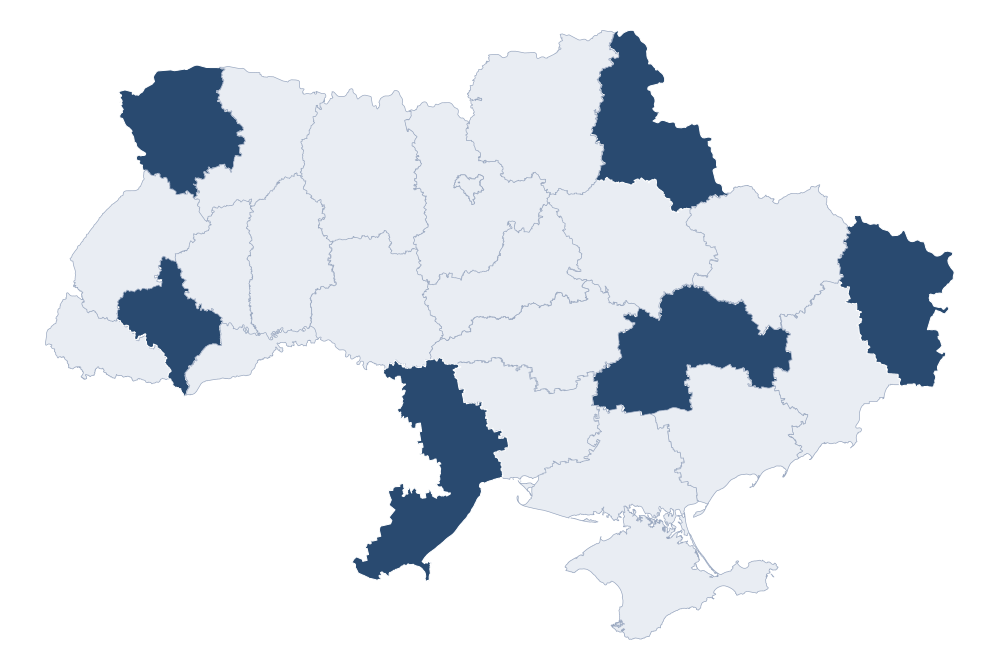
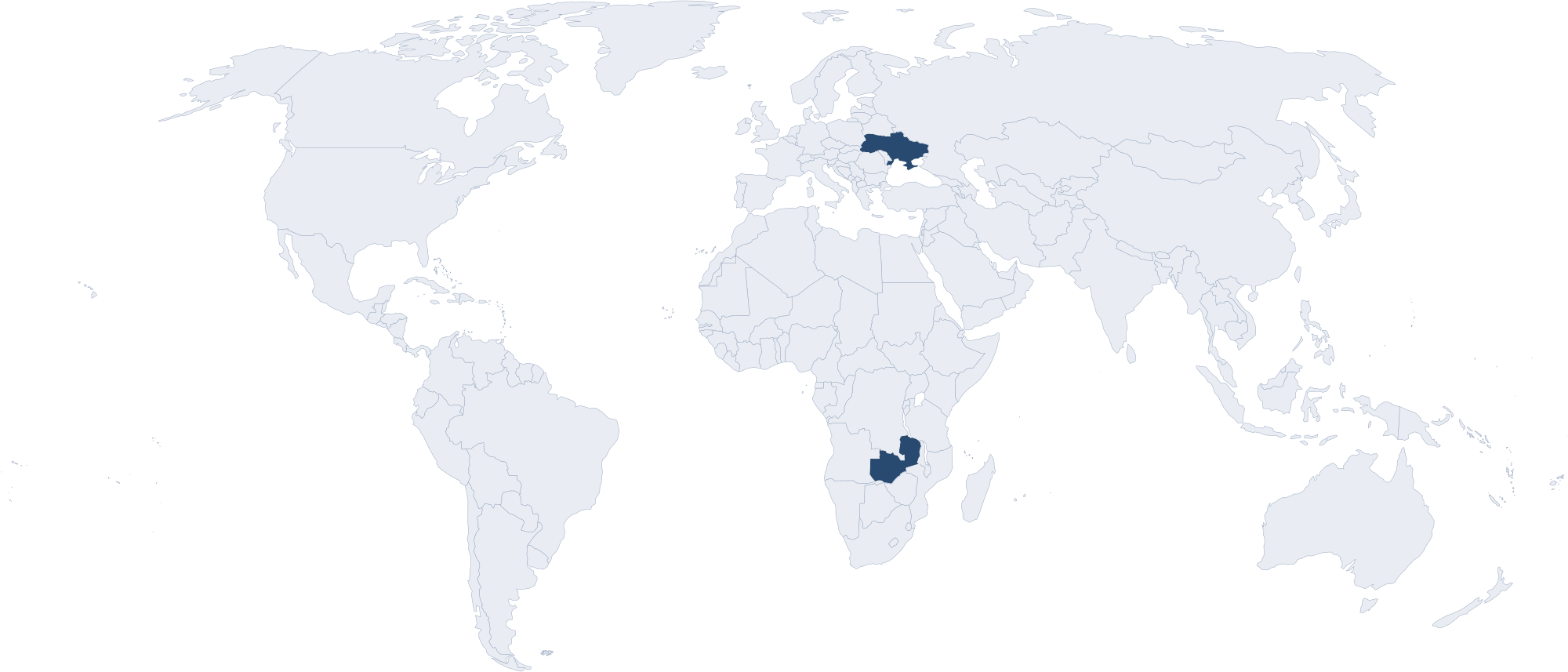
The qualification center assesses and recognizes individuals’ learning outcomes, including those obtained through non-formal or informal education, and assigns or confirms professional qualifications in accordance with professional standards and procedures.
Qualification assessment UkraineThe institution’s mission is practical education to overcome the shortage of qualified personnel in Zambia and the SADC region; its programmes cover business, education, technology, and community development — from short micro-qualifications to full diploma programmes.
ZeroCall approbation ZambiaA vocational lyceum that provides the acquisition of skilled trades together with full general secondary education for the young people of the community.
ZeroCall approbation UkraineThe institution trains future specialists for many mining enterprises of Kryvyi Rih, as well as for other enterprises of the industrial city.
ZeroCall approbation UkraineA multi-profile institution of the third (higher) level of vocational education that provides training, retraining, and skills upgrading in seven economic areas: general occupations for all sectors of the economy; road transport; public catering; trade and commerce; the service sector; agriculture; and the electrical-engineering field.
ZeroCall approbation UkraineA multi-profile vocational education center that trains skilled workers for industry, construction, and the service sector of Novovolynsk and the region.
ZeroCall approbation UkraineA higher vocational school specializing in training specialists in construction and architectural-finishing trades.
ZeroCall approbation UkraineA higher vocational school that trains skilled workers across a wide range of trades to meet the needs of the local labor market.
ZeroCall approbation UkraineA vocational education center training skilled personnel for industry, transport, and the service sector.
ZeroCall approbation UkraineA vocational lyceum that combines the acquisition of a skilled trade with full general secondary education.
ZeroCall approbation UkraineA higher vocational school with a long-standing tradition of training skilled workers in in-demand trades.
ZeroCall approbation UkraineA vocational education center focused on training in-demand skilled trades for the regional economy.
ZeroCall approbation UkraineA regional vocational college that provides vocational (vocational-technical) education across a variety of training fields.
ZeroCall approbation UkraineA vocational-technical school that provides the acquisition of skilled trades and general secondary education for the young people of the community.
ZeroCall approbation UkraineA vocational education center that trains skilled workers for the needs of local communities and enterprises.
ZeroCall approbation UkraineA vocational-technical school for the training of skilled personnel and the acquisition of general secondary education.
ZeroCall approbation UkraineA vocational lyceum that provides vocational training to young people in skilled trades of regional demand.
ZeroCall approbation UkraineA separate structural unit of NUFT — a professional college training junior specialists and junior bachelors, in particular for the food industry.
ZeroCall approbation UkraineA technical professional college within Lutsk NTU that trains specialists in technical and engineering fields.
ZeroCall approbation UkraineA technical professional college of Lutsk NTU training specialists in technical and production specialties.
ZeroCall approbation UkraineA state educational institution within the State Employment Service system that provides vocational training, retraining, and skills upgrading for adults in skilled trades in line with labor market needs.
ZeroCall approbation UkraineLicense and use
The platform is distributed under a free license — it may be used, modified, and integrated without restrictions.
Permission is hereby granted, free of charge, to any person obtaining a copy of this software and associated documentation files (the “Software”), to deal in the Software without restriction, including without limitation the rights to use, copy, modify, merge, publish, distribute, sublicense, and/or sell copies of the Software, and to permit persons to whom the Software is furnished to do so, subject to the following conditions: The above copyright notice and this permission notice shall be included in all copies or substantial portions of the Software. THE SOFTWARE IS PROVIDED “AS IS”, WITHOUT WARRANTY OF ANY KIND, EXPRESS OR IMPLIED, INCLUDING BUT NOT LIMITED TO THE WARRANTIES OF MERCHANTABILITY, FITNESS FOR A PARTICULAR PURPOSE, AND NONINFRINGEMENT. IN NO EVENT SHALL THE AUTHORS OR COPYRIGHT HOLDERS BE LIABLE FOR ANY CLAIM, DAMAGES, OR OTHER LIABILITY, WHETHER IN AN ACTION OF CONTRACT, TORT, OR OTHERWISE, ARISING FROM, OUT OF, OR IN CONNECTION WITH THE SOFTWARE OR THE USE OR OTHER DEALINGS IN THE SOFTWARE.
Join the integration of IDAP at your educational institution
We invite vocational education institutions, qualification centers, and private organizations to the first cohort for integrating the IDAP platform into the assessment process. No more than 10 institutions will be selected for Round #1. Participants receive training, technical support, and free hosting allocation for a period of 1 year.
📋 Conditions of participation
- Participation in 2 webinars — online training sessions on platform setup and assessment methodology.
- Use of the system in the assessment process — applying IDAP to test learners at your institution.
- On-site approbation report — preparing a short report on the results of the platform’s implementation.
🎁 What you receive
- Training — hands-on webinars and supporting materials for administrators and teachers.
- Technical support — help with deployment and configuration throughout the participation period.
- Hosting allocation for 1 year — full IDAP functionality without restrictions for 12 months.
Application for participation — Round #1
Fill in the form below. Fields marked with * are required. After submission, your email client will open with a ready-made message to info@idap.org.ua.
Interested in the platform?
IDAP was developed and implemented at the Training and Practical Center “Electrician for Repair and Maintenance of Electrical Equipment”.
Download center Learn more about the Training and Practical CenterSystem documentation
The complete technical documentation of the IDAP platform contains a detailed description of the installation process, system structure, database, security settings, and use scenarios.
The documentation is intended both for system administrators and for technical specialists responsible for deploying and supporting the platform in an educational institution.
Have questions or found an error?
Write to us — we are open to feedback, suggestions, and reports about inaccuracies in the platform.
Have questions?
If you have questions about installing, configuring, or using IDAP, send us a message.
Ask a questionFound an error?
If you notice a technical error, a text inaccuracy, or a problem during testing, please let us know.
- the page or section where the error occurred;
- a short description of the problem;
- what exactly you were doing before the error appeared;
- a screenshot, if possible.
© 2026 Nazarii Hladun · idap.org.ua · IDAP Build 2 (14.05.2026) · MIT License